Ten of Cups
Explore the history and symbolism of the Ten of Cups tarot card, from Marseille origins to the Rider-Waite-Smith rainbow scene and Thoth tradition of satiety.
Etymology & Name
The card name follows the standard numerical convention: "Dieci di Coppe" in Italian and "Dix de Coupes" in French, deriving from the Latin "decem." In the Golden Dawn system, the Ten of Cups was assigned to the third decan of Pisces, ruled by Mars, giving it the Qabalistic title "Lord of Perfected Success," which Crowley renamed "Satiety" in the Thoth Tarot. The number ten represents completion, culmination, and the end of a cycle. In the Qabalistic Tree of Life, the tenth sphere is Malkuth (the kingdom, the material world).
Early Imagery
In the Marseille tradition, the Ten of Cups displayed ten cup-shaped vessels arranged in a symmetrical pattern, typically in a triangular or tree-like formation. The Noblet deck and Dodal deck showed ten cups in a balanced arrangement. No human figures or narrative scenes were depicted. The arrangement of ten objects often suggested the Qabalistic Tree of Life, three on each of two side pillars and four across the base.
Rider-Waite-Smith Design
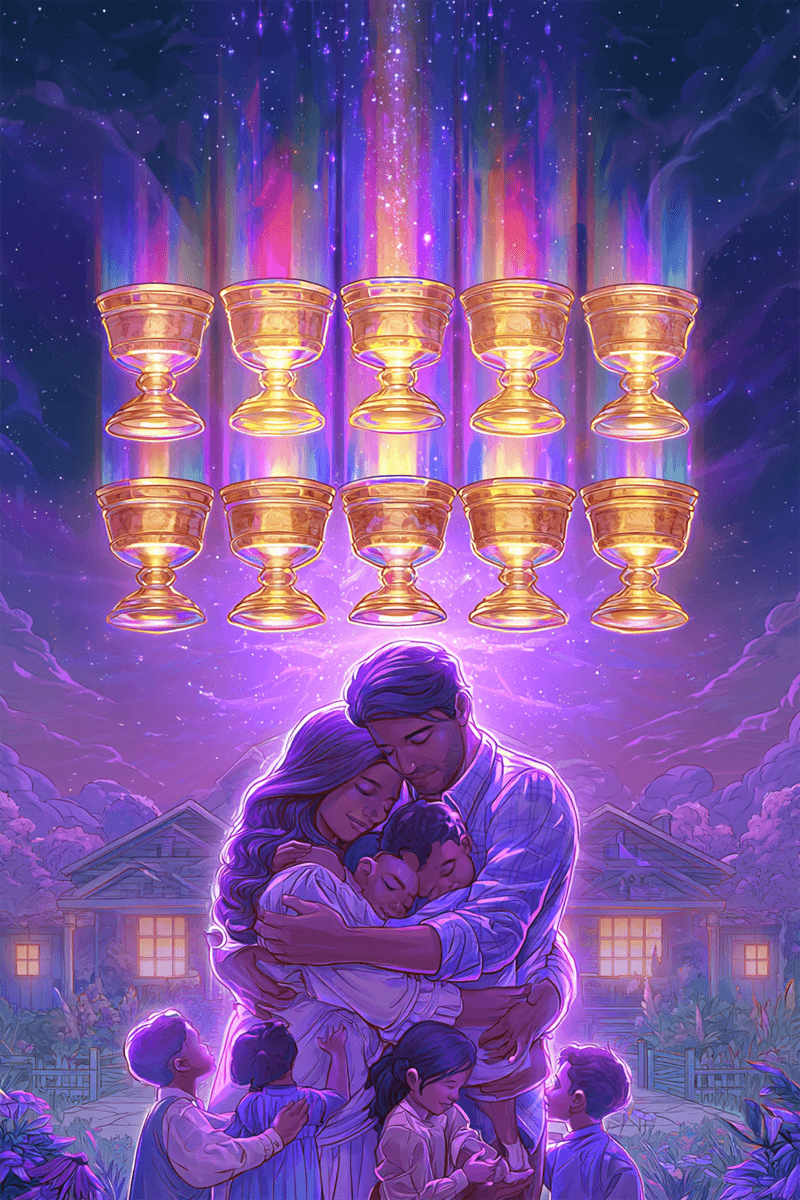
Pamela Colman Smith 1909 illustration creates a vision of domestic joy and ultimate emotional fulfillment. A couple stands with arms raised in a gesture of joy and gratitude, looking up at a rainbow that arches across the sky. The rainbow is composed of or accompanied by ten cups arranged in an arc. Below the rainbow, two children dance or play together. In the background, a house nestles beside a river, with green hills and trees completing the pastoral landscape. Arthur Edward Waite described the card as representing "contentment" and "repose of the heart." The rainbow represents the biblical covenant between God and humanity.
Key Symbolism
The Ten of Cups is built around the archetype of ultimate emotional fulfillment and domestic harmony. The rainbow is the card central symbol: in the biblical tradition, it represents God covenant with Noah after the Flood, a promise that destruction will not come again. The ten cups arranged in the rainbow arc represent the complete cycle of emotional experience. The couple with raised arms represents the human response to divine blessing. Place notes that the two children dancing represent the next generation, the fruit of the couple love. The house represents home, security, and domestic stability.
Across Traditions
The Marseille tradition presents ten chalices in a symmetrical, often Tree-of-Life-like pattern with no figures. Pamela Colman Smith 1909 RWS design introduced the iconic scene of a couple and children beneath a rainbow of cups. The Thoth Tarot depicts ten lotus-cups with water overflowing from every vessel in a continuous cascade. Crowley titled the card "Satiety" and assigned it to Mars in Pisces, emphasizing the point where emotional fullness becomes excessive, the cups overflow not with joy but with the surfeit of too much.
Cultural Context
The Ten of Cups is assigned to the third decan of Pisces (20-30 degrees), ruled by Mars. Helen Farley notes that the theme of domestic happiness and family fulfillment has deep roots in Western cultural traditions, from the biblical ideal of the blessed household to the Victorian cult of domesticity. The rainbow as a symbol of divine covenant and hope has its most direct source in the biblical story of Noah. In the context of the suit of Cups, this card represents the culmination of the entire suit journey, from the pure potential of the Ace to this final vision of complete emotional realization.