Ten of Pentacles
Discover the history and symbolism of the Ten of Pentacles tarot card, from the Marseille pip to the Rider-Waite-Smith multi-generational family scene.
Etymology & Name
The number ten in tarot signifies completion, culmination, and the fullness of a cycle. The Ten of Pentacles combines the finality of ten with the legacy of coins. The card is assigned to the third decan of Virgo (20-30 degrees), ruled by Mercury, combining the precision of Virgo with the communication of Mercury.
Early Imagery
In the Marseille tradition the Ten of Pentacles showed ten coins in a pattern that often suggested a complete arrangement, the fullness of material accumulation. The geometric design conveyed the stability of lasting wealth.
Rider-Waite-Smith Design
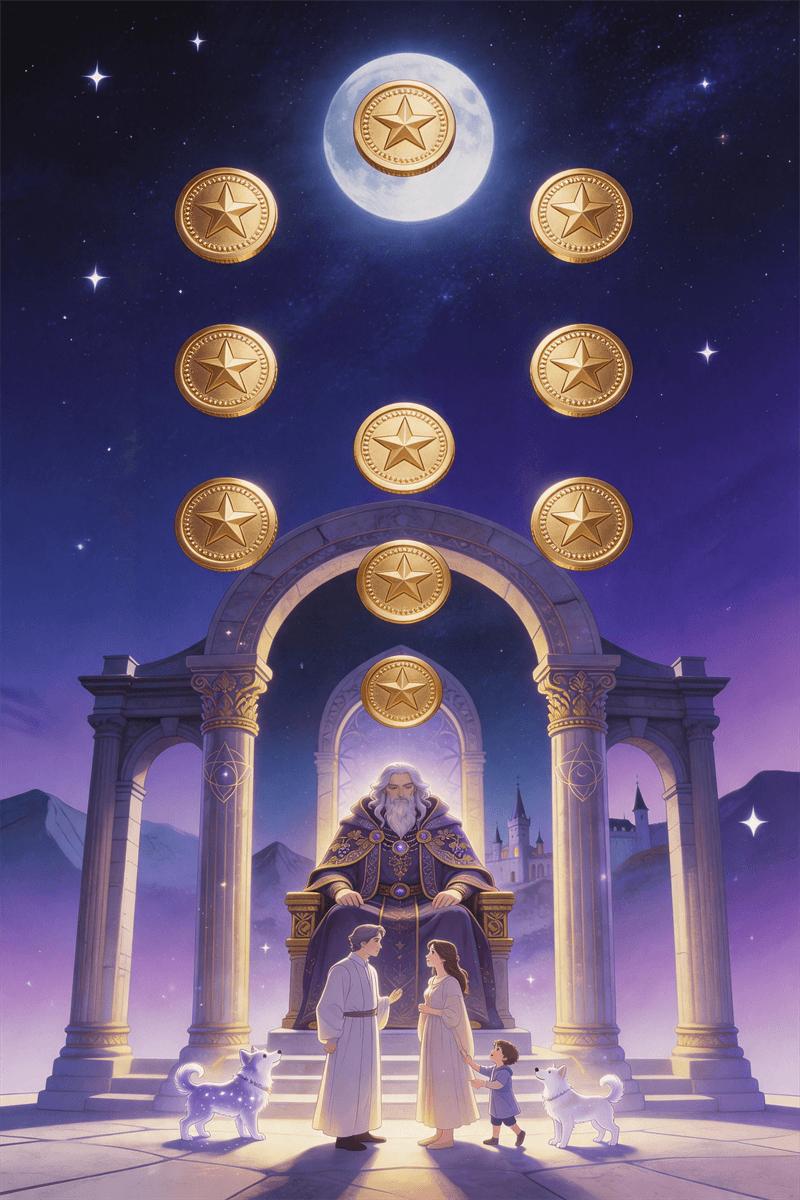
Pamela Colman Smith 1909 illustration depicts a multi-generational family scene. An old man sits wrapped in a robe, while a younger man and woman stand with a child and dogs. Ten pentacles are arranged throughout the scene, on the archway, the ground, and the figures. The image is one of legacy: the wealth of one generation becoming the foundation of the next.
Key Symbolism
The Ten of Pentacles represents legacy, family wealth, and the completion of a material cycle. The old man is the patriarch whose work has built the fortune. The younger family is the legacy that will inherit it. The pentacles scattered throughout the scene are the permeation of wealth through the generations. The card asks: what are you building that will outlast you?
Across Traditions
The Marseille tradition shows ten coins in a geometric pattern. The RWS design introduced the family scene, drawing on the medieval tradition of the household and the lineage. In the Thoth Tarot Crowley titled the card "Wealth" and depicted ten disks in a complete arrangement, emphasizing the material fulfillment of the suit. Crowley assigned it to Mercury in Virgo.
Cultural Context
The Ten of Pentacles is assigned to Mercury in Virgo. Helen Farley notes that the family scene draws on the medieval tradition of the household, the basic unit of economic and social life. The card also reflects the biblical tradition of the house built on a firm foundation. In the context of the suit, this card represents the material realm at its most complete: the wealth that has become legacy.