Ten of Wands
The Ten of Wands: from Marseille arranged batons to the Rider-Waite-Smith burdened figure carrying ten staves — the weight of completion, overreach, and the close of a long labor.
Etymology & Name
The suit derives from the Italian 'Bastoni' (clubs, staves) and the French 'Bâtons' (batons). The ten of batons was 'Dieci di Bastoni' or 'Dix de Bâtons' in the playing-card tradition, with no individual name. The divinatory meaning of burden and overreach was assigned by nineteenth-century occultists, drawing on the heavy, completed quality of the number ten combined with the limiting pressure of Saturn on the mutable fire of Sagittarius.
Early Imagery
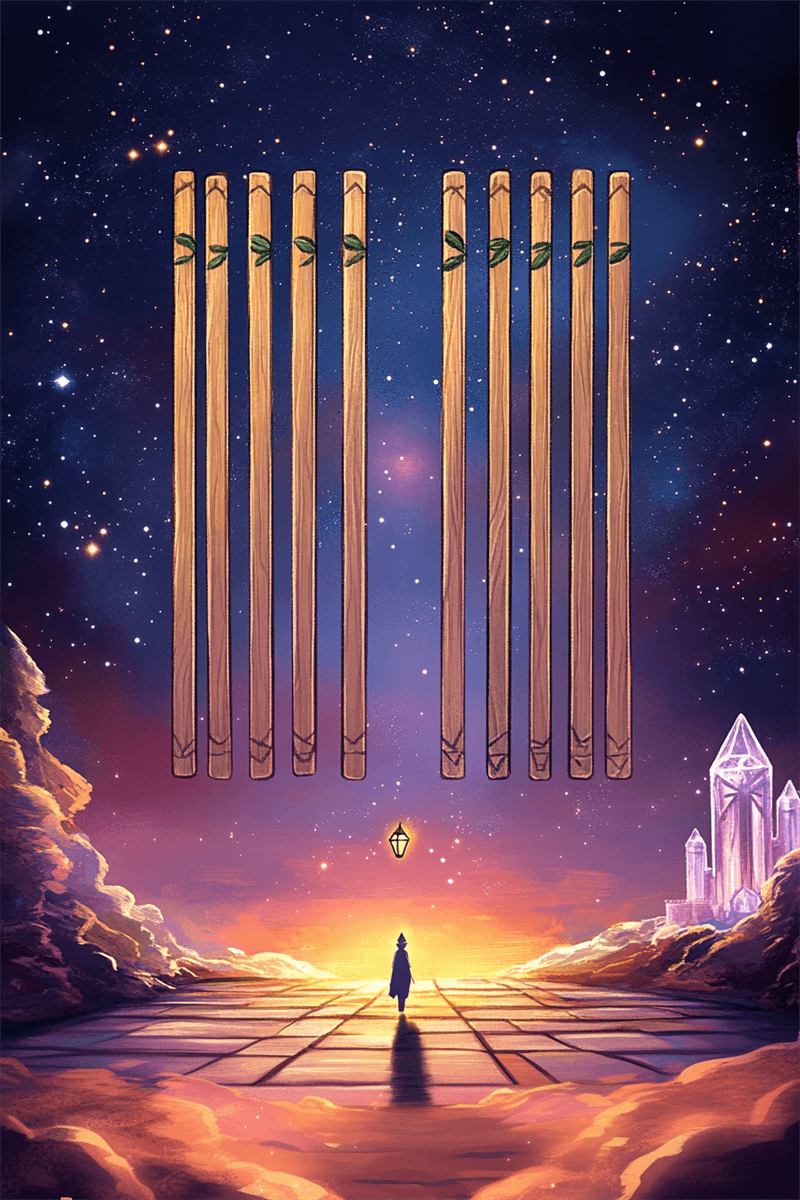
In the Marseille tradition the Ten of Batons showed ten batons arranged in a tight, often lattice-like pattern, with leafy ornament between them. The composition was decorative, not scenic — there was no figure, no burden, no journey. The dense grid of ten batons filled the frame, and meaning was carried by number and suit alone.
Rider-Waite-Smith Design
Pamela Colman Smith placed a single bent figure walking toward a town gate in the distance, struggling under a heavy bundle of ten wands tied together and carried across his back. His head is lowered, his red tunic and yellow stockings bright against the pale yellow sky. The town is close — the journey is nearly over — but the load is at its heaviest in the last steps.
Key Symbolism
The ten wands bound together are the accumulated weight of every step that has come before — the burden of the suit carried to its conclusion. The figure's bent posture is the cost of completion, the price of having taken on too much. The town ahead is the destination, close but not yet reached. The number ten is both completion and excess, and the card captures the moment when a successful enterprise has become heavy enough to crush the one who carries it.
Across Traditions
The Marseille Ten is a dense arrangement of batons with no scene. Smith's illustration made the metaphor of burden literal, showing the figure crushed by the load he carries. In the Thoth deck Crowley titles the card 'Oppression', attributes it to Saturn in Sagittarius, and renders ten wands arranged as a heavy wheel pressed down by a Saturnine sigil — the cruel, limiting weight of Saturn on the fire that has burned to its end.
Cultural Context
The Golden Dawn assigned the Ten of Wands to Saturn in Sagittarius, the third decan of Sagittarius — the planet of restriction and time pressing down on the sign of long journeys and high aims. The image of the burdened walker recalls the laborer, the pilgrim, and anyone who has taken on more than they can comfortably carry. As the tenth and final numbered card of the suit it closes the cycle that began in the Ace, asking what the will has cost and whether the load can be set down.