Two of Cups
Discover the history and symbolism of the Two of Cups tarot card, from its Marseille origins to the Rider-Waite-Smith caduceus design and Thoth tradition.
Etymology & Name
The designation "Two of Cups" follows the straightforward numerical naming convention used in Italian tarot since the 15th century. "Due" (Italian) and "deux" (French) derive from the Latin "duo." In the Golden Dawn astrological system, the Two of Cups was assigned to the first decan of Cancer, ruled by Venus, giving the card its Qabalistic title "Lord of Love." Ronald Decker notes in "The Esoteric Tarot" that the planetary attribution of Venus in Cancer gave this card its enduring association with partnership and romantic union, though this meaning was a later occult overlay on what was originally simply a numbered playing card.
Early Imagery
In the Marseille tradition, the Two of Cups displayed two cup-shaped vessels arranged symmetrically, typically flanking a central decorative motif. In the Noblet deck (c. 1650) and the Dodal deck (c. 1701), the two cups were positioned side by side, often separated by a floriated ornament. The Conver deck (1760) maintained this arrangement. Stuart Kaplan documents in "The Encyclopedia of Tarot" how the Marseille pattern showed remarkable consistency in the placement and style of the suit symbols. As with all numbered minor arcana cards in the Marseille tradition, there were no human figures, no narrative scene, and no action depicted, only the two suit symbols and their surrounding decoration.
Rider-Waite-Smith Design
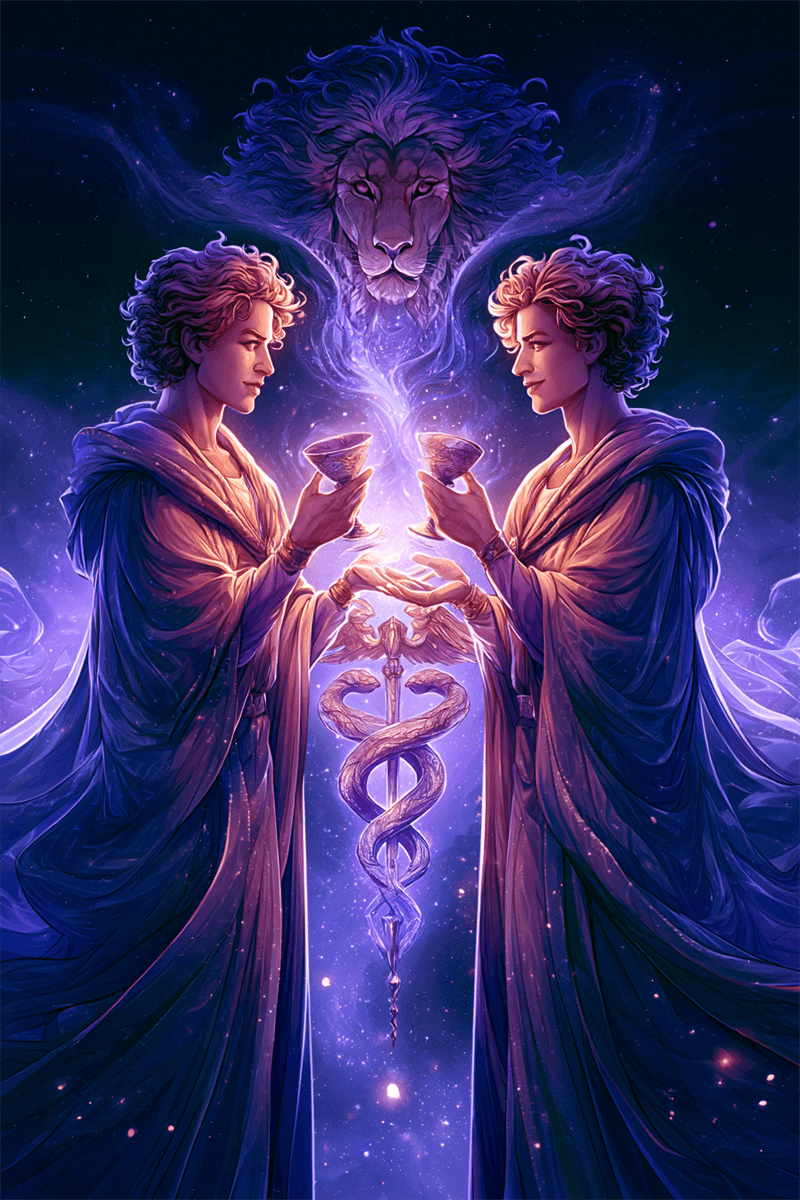
Pamela Colman Smith 1909 illustration for the Two of Cups transforms the static Marseille design into a narrative scene of partnership. Two figures, a man and a woman, stand facing each other, each holding a cup, appearing to exchange or toast with their vessels. Between them rises a caduceus: two serpents entwined around a central staff, topped by a winged lion head. Robert Place notes that the lion head atop the caduceus may reference the astrological sign of Leo, suggesting solar or regal energy presiding over the union. Arthur Edward Waite described the card in "The Pictorial Key to the Tarot" as representing "love" and "reciprocal affection." The exchange of cups between the two figures evokes both the romantic tradition of lovers cups and the ritual of betrothal.
Key Symbolism
The Two of Cups is rich in symbolic content, much of it introduced by Pamela Colman Smith. The caduceus, the twin-serpent staff of Hermes, is perhaps the most significant symbol, representing the union of opposites and the alchemical concept of coniunctio. The winged lion head atop the staff combines solar symbolism with the concept of elevation and transcendence. The two cups being exchanged evoke the medieval tradition of "loving cups," shared vessels used in betrothal ceremonies. Decker notes in "The Esoteric Tarot" that the Golden Dawn associated this card with Venus in Cancer, linking the planet of love with the sign ruling home, family, and emotional bonds.
Across Traditions
The Marseille tradition presents the Two of Cups as two simple chalices with floral ornamentation between them, a static, non-narrative design with no human figures. Pamela Colman Smith 1909 RWS design revolutionized this card by adding the two exchanging figures and the caduceus. The Thoth Tarot offers yet another interpretation: Crowley and Harris depicted two lotus-blooms overflowing into a shared pool of water, with a flame rising between them. Crowley titled the card "Love" and assigned it to Venus in Cancer. Unlike the RWS, the Thoth version contains no human figures, instead using abstract floral and elemental symbolism.
Cultural Context
The Two of Cups is assigned to the first decan of Cancer (0-10 degrees), ruled by Venus in the Chaldean decan system adopted by the Golden Dawn. Helen Farley notes in "A Cultural History of Tarot" that the theme of partnership and mutual exchange has deep roots in Western cultural traditions, from the biblical concept of two becoming one flesh to the Renaissance ideal of courtly love. The medieval tradition of the "loving cup," a shared drinking vessel passed between companions at banquets and ceremonies, provides a concrete historical referent for the imagery.