Two of Pentacles
Discover the history and symbolism of the Two of Pentacles tarot card, from the Marseille pip to the Rider-Waite-Smith juggler with two coins and an infinity sign.
Etymology & Name
The number two in tarot signifies duality, balance, and adaptation. The Two of Pentacles combines the pairing of coins with the need to juggle opposing demands. The card is assigned to the first decan of Capricorn (0-10 degrees), ruled by Jupiter, combining the discipline of Capricorn with the expansion of Jupiter.
Early Imagery
In the Marseille tradition the Two of Pentacles showed two coins connected by a ribbon or arc, often with the coins in motion. The arrangement suggested the continuous exchange and balancing of resources.
Rider-Waite-Smith Design
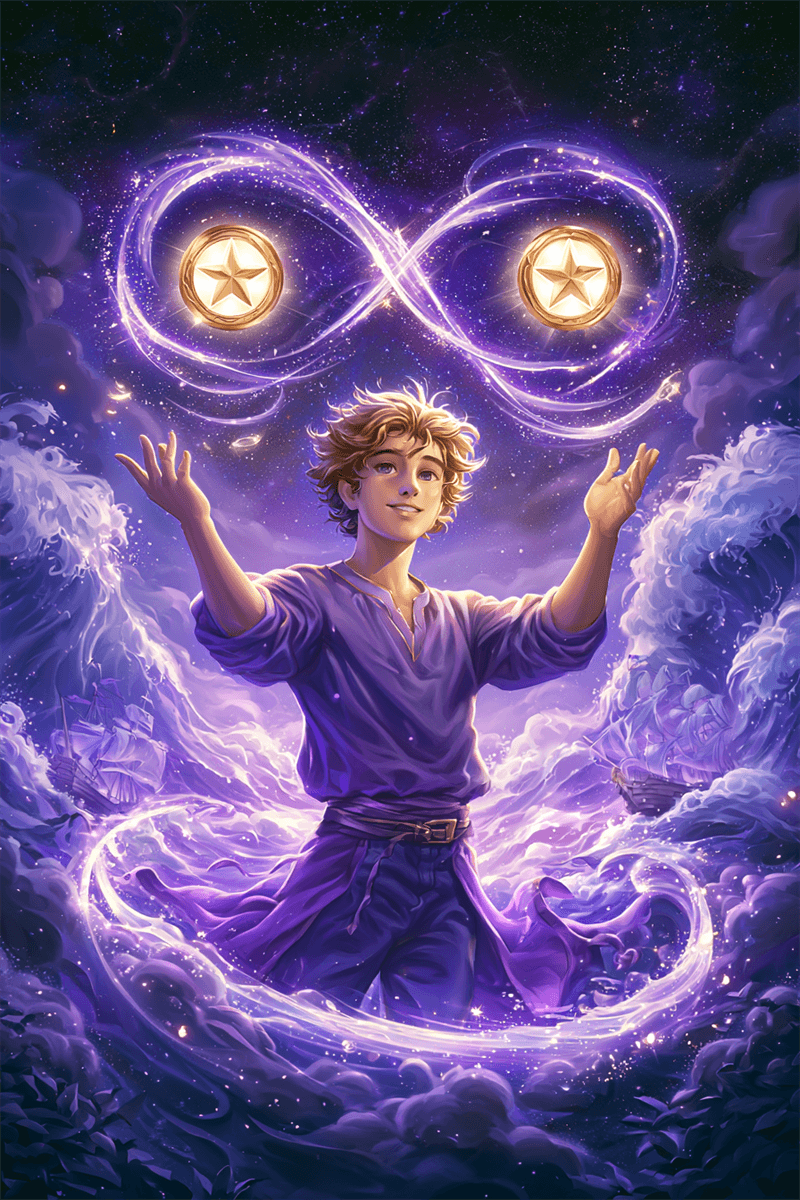
Pamela Colman Smith 1909 illustration depicts a young man juggling two coins, connected by an infinity sign. Behind him, two ships ride the waves of a turbulent sea. The figure dances on the shore, his hat held by a trailing scarf. The image is one of adaptation: the juggler must keep both coins in motion or drop them both. The ships signify the larger forces at play.
Key Symbolism
The Two of Pentacles represents the need to balance competing demands, the juggling act of daily life. The infinity sign connecting the coins is the endless cycle of adjustment. The ships on the turbulent sea are the external circumstances that require constant adaptation. The figure dances rather than struggles, suggesting that flexibility is the key. The card asks: can you keep all your commitments in motion?
Across Traditions
The Marseille tradition shows two coins connected by a ribbon. The RWS design introduced the juggler and the infinity sign, drawing on the medieval tradition of the fool or juggler. In the Thoth Tarot Crowley titled the card "Change" and depicted two disks rotating around each other, emphasizing the cyclical nature of adaptation. Crowley assigned it to Jupiter in Capricorn.
Cultural Context
The Two of Pentacles is assigned to Jupiter in Capricorn. Helen Farley notes that the juggler draws on the medieval tradition of the gleeman or entertainer, a figure of adaptability. The card also reflects the merchant tradition of balancing accounts. In the context of the suit, this card represents the first challenge of the material realm: the need to manage competing resources.