Three of Cups
Learn about the history and symbolism of the Three of Cups tarot card, from Marseille patterns to the Three Graces imagery of the Rider-Waite-Smith deck.
Etymology & Name
The card name follows the standard numerical convention: "Tre di Coppe" in Italian and "Trois de Coupes" in French, both deriving from the Latin "tres." In the Golden Dawn system, the Three of Cups was assigned to the second decan of Cancer, ruled by Mercury, giving it the Qabalistic title "Lord of Abundance." Robert Place notes that the number three in tarot numerology often signifies the first manifestation of creative energy after the initial impulse and duality, the third point that creates a plane or social unit.
Early Imagery
In the Marseille tradition, the Three of Cups displayed three cup-shaped vessels arranged in a triangular formation, typically with floral ornamentation between them. The Noblet deck (c. 1650) and Dodal deck (c. 1701) showed the three cups in a pyramidal arrangement. The Conver deck (1760) maintained this triangular layout. Stuart Kaplan documents how the Marseille pattern consistently used symmetrical arrangements of suit symbols to convey the card number. No human figures or narrative scenes were depicted.
Rider-Waite-Smith Design
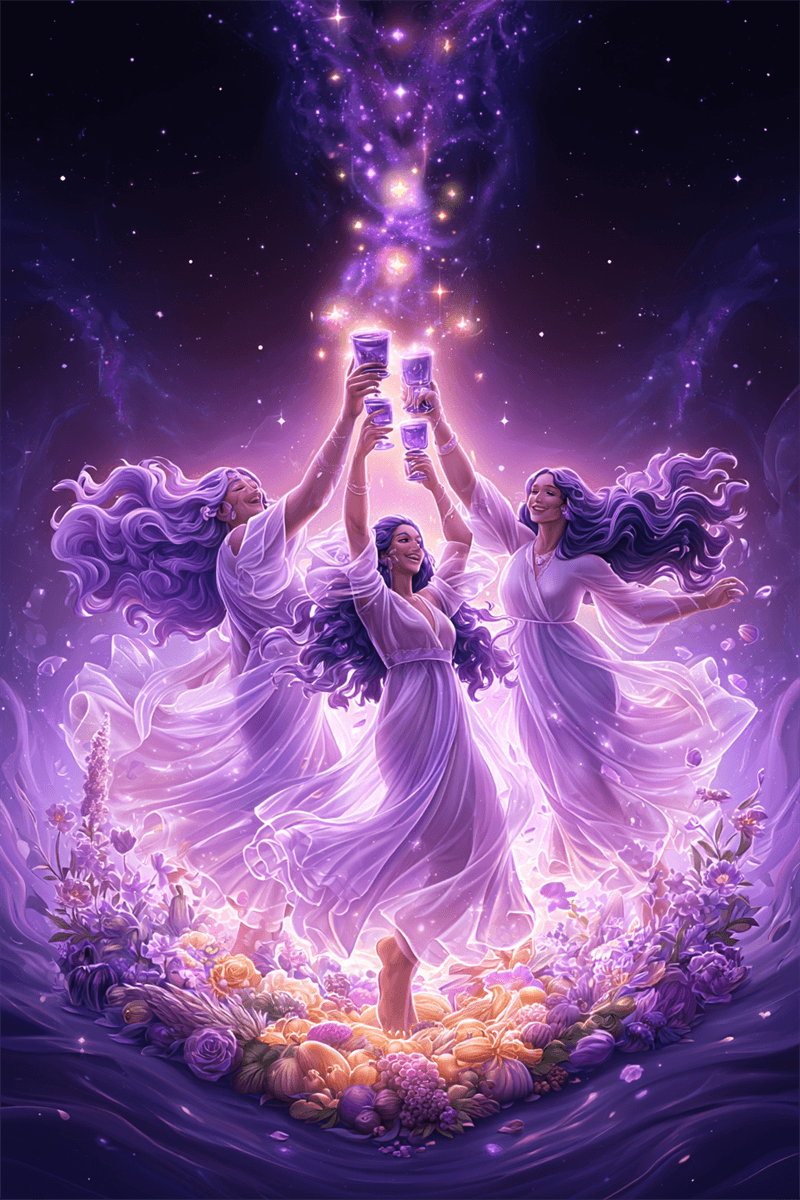
Pamela Colman Smith 1909 illustration transforms the static Marseille arrangement into a joyful narrative scene. Three young women, dressed in flowing garments of different colors, dance in a circle with arms raised, each holding a cup aloft. The setting is a garden or meadow, with fruits and flowers strewn on the ground. The dancing figures evoke the Three Graces (Charites) of Greek mythology, Aglaia, Euphrosyne, and Thalia, who represented beauty, joy, and abundance. Arthur Edward Waite described the card as representing "merriment" and "the conclusion of a matter."
Key Symbolism
The Three of Cups is layered with cultural and symbolic associations. The three dancing women directly reference the Three Graces of Greek mythology. The harvest fruits on the ground connect the card to traditions of harvest festivals and the rites of Demeter and Dionysus. The number three represents completion of a first cycle. The circular dance formation echoes the sacred circle, a universal symbol of unity and the cycles of nature. Decker notes that the Golden Dawn assignment of Mercury in Cancer links the card to communicative joy and emotional exchange.
Across Traditions
The Marseille tradition presents three chalices in a triangular pattern with floral ornamentation, a static design with no figures. Pamela Colman Smith 1909 RWS design introduced the three dancing women. The Thoth Tarot depicts three lotus-cups arranged in a pyramid, with water overflowing from each vessel into a shared pool. Crowley titled the card "Abundance" and emphasized the overflowing, generous quality of emotional and material plenty.
Cultural Context
The Three of Cups is assigned to the second decan of Cancer (10-20 degrees), ruled by Mercury. Helen Farley notes that the theme of communal celebration has deep roots in European folk traditions, from the Roman feast of Saturnalia to medieval harvest festivals. The Three Graces of Greek mythology were among the most popular subjects in Renaissance art. In the context of the suit of Cups, this card represents the expansion of emotional energy beyond the pair bond into the broader community.