Five of Cups
Discover the history and symbolism of the Five of Cups tarot card, from Marseille origins to the Rider-Waite-Smith scene of loss and the Thoth tradition of disappointment.
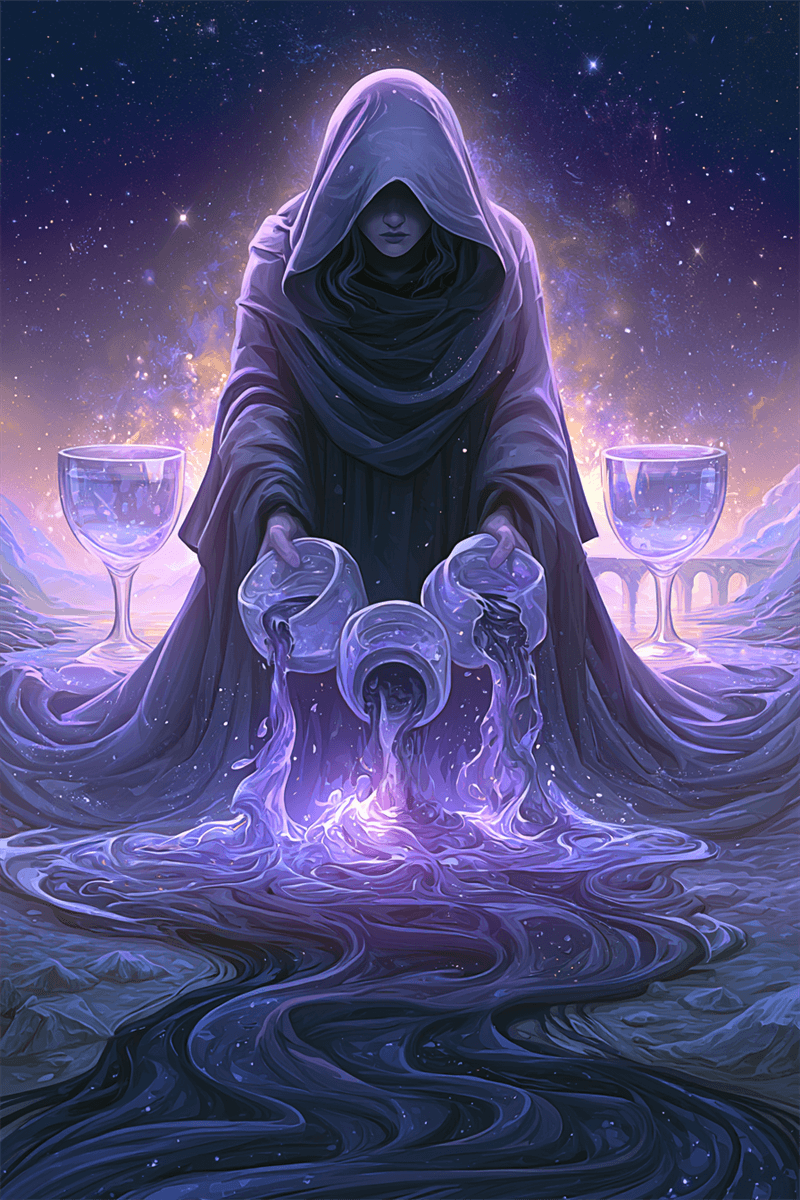
Etymology & Name
The card name follows the standard numerical convention: "Cinque di Coppe" in Italian and "Cinq de Coupes" in French, deriving from the Latin "quinque." In the Golden Dawn system, the Five of Cups was assigned to the first decan of Scorpio, ruled by Mars, giving it the Qabalistic title "Lord of Loss of Pleasure," which Crowley shortened to "Disappointment" in the Thoth Tarot. The number five represents change, disruption, and the introduction of instability. In the Qabalistic Tree of Life, the fifth sphere is Geburah, the sphere of severity, judgment, and the destructive force that clears away the old.
Early Imagery
In the Marseille tradition, the Five of Cups displayed five cup-shaped vessels arranged in a symmetrical pattern, typically with a central design element. The Noblet deck (c. 1650) and Dodal deck (c. 1701) showed five cups in a balanced arrangement, often forming a quincunx or cross-like formation. No human figures or narrative scenes were depicted. The abstract design relied on the number five associations with disruption and change combined with the suit emotional domain.
Rider-Waite-Smith Design
Pamela Colman Smith 1909 illustration creates a poignant narrative of loss and mourning. A figure wrapped in a long black cloak stands on a riverbank, head bowed, gazing at three cups that have been knocked over, their contents spilling onto the ground. Behind the figure, two upright cups remain standing, but the figure back is turned to them, focused entirely on what has been lost. In the distance, a stone bridge crosses the river, leading toward a castle or fortified structure on a hill. Arthur Edward Waite described the card as representing "loss" and "what has been," while hinting at the possibility of recovery through the upright cups and the bridge.
Key Symbolism
The Five of Cups is dense with symbolic meaning. The three spilled cups represent what has been lost, their contents irretrievably flowing into the earth. The two upright cups behind the figure represent what remains, existing resources or relationships that are still intact but ignored in the moment of grief. The black cloak is a universal symbol of mourning. The river flowing beside the figure represents the passage of time and the flow of emotions. The bridge in the distance is a powerful symbol of transition, from grief to acceptance, from loss to renewal. Place notes that the castle on the hill represents stability and home, suggesting that security still exists.
Across Traditions
The Marseille tradition presents five chalices in a symmetrical pattern with no figures. Pamela Colman Smith 1909 RWS design introduced the mourning figure, the spilled cups, and the bridge. The Thoth Tarot depicts five lotus-cups arranged in an inverted pentagram pattern, with dark, murky water flowing between them. Crowley titled the card "Disappointment" and assigned it to Mars in Scorpio, emphasizing the destructive, painful quality of this combination. The inverted pentagram reinforces the theme of emotional disruption.
Cultural Context
The Five of Cups is assigned to the first decan of Scorpio (0-10 degrees), ruled by Mars. The shift from Cancer (cards 2-4) to Scorpio marks a dramatic transition from nurturing energy to intense, confrontational energy. Helen Farley notes that the theme of loss and mourning has deep roots in Western cultural traditions, from Greek elegies for the dead to the medieval ars moriendi tradition. The image of the mourner by the river evokes classical imagery of the river Styx and the underworld.