Five of Wands
The Five of Wands: from Marseille arranged batons to the Rider-Waite-Smith youths striving with staves — competition, conflict, and the productive friction of competing wills.
Etymology & Name
The suit derives from the Italian 'Bastoni' (clubs, staves) and the French 'Bâtons' (batons). The five of batons was 'Cinque di Bastoni' or 'Cinq de Bâtons' in the playing-card tradition, with no individual name. The divinatory meaning of strife and competition was assigned by nineteenth-century occultists, drawing on the unstable, transitional quality of the number five combined with the suit of fire.
Early Imagery
In the Marseille tradition the Five of Batons showed five batons arranged in a radiating or woven pattern, often with leafy ornament and small hands. The composition was decorative, not narrative — there were no figures, no scene, no combat. Any sense of conflict was carried by the number five and the suit of fire, not by the picture itself.
Rider-Waite-Smith Design
Pamela Colman Smith filled the frame with five youths in bright clothing, each wielding a wand at a different angle, all apparently contesting the same narrow ground. The wands cross and clash overhead, the figures strain against one another, and the bright sky behind suggests the contest takes place in the open air. The image reads as a mock battle, a tournament, or a noisy quarrel.
Key Symbolism
The five wands crossing in the air are competing wills, none of them dominant; the youths are roughly equal in strength, and the contest has no clear winner. The card captures the friction that arises when five different fires try to occupy the same space. Yet the struggle is shown in daylight and with youthful energy — it is productive competition, not war. The number five marks the disruption of four's stability by a fifth element.
Across Traditions
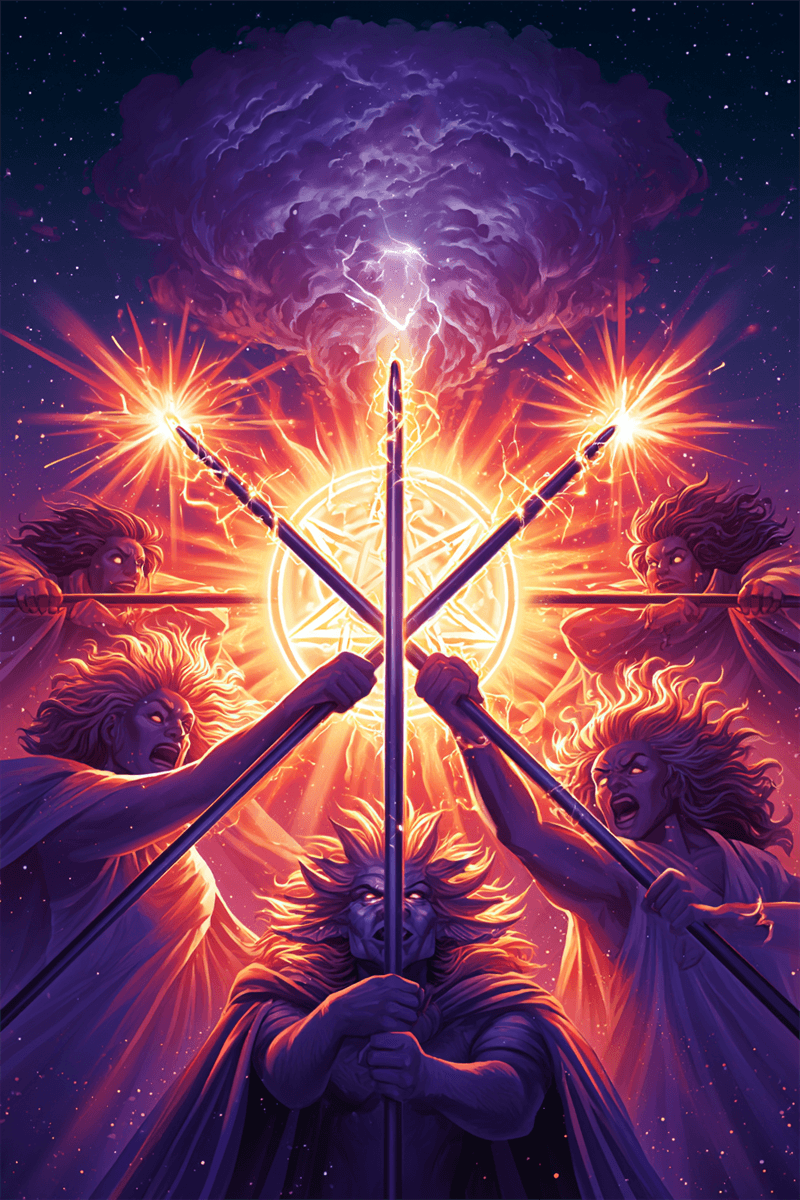
The Marseille Five is a decorative arrangement of batons with no scene. Smith's illustration made the metaphor of 'strife' literal, showing youths in active contest. In the Thoth deck Crowley titles the card 'Strife' and attributes it to Saturn in Leo, rendering five wands radiating from a central wheel with flame and a ram's-head motif — the heavy, restrictive pressure of Saturn on the king-of-fire sign.
Cultural Context
The Golden Dawn assigned the Five of Wands to Saturn in Leo, the first decan of Leo — the bright fixed fire of summer challenged by the limiting force of Saturn. The image of contending youths echoes Renaissance mock-battles, the bois joli of May Day games, and the martial training of young nobles. As the fifth card of the suit it disrupts the harmony of the Four and introduces the friction that forces growth.