Six of Wands
The Six of Wands: from Marseille arranged batons to the Rider-Waite-Smith crowned rider laureled and acclaimed — victory, public recognition, and the disciplined will that earns it.
Etymology & Name
The suit derives from the Italian 'Bastoni' (clubs, staves) and the French 'Bâtons' (batons). The six of batons was 'Sei di Bastoni' or 'Six de Bâtons' in the playing-card tradition, with no individual name. The divinatory meaning of victory and recognition was assigned by nineteenth-century occultists, drawing on the balanced, harmonious quality of the number six and the triumphant fire of Leo.
Early Imagery
In the Marseille tradition the Six of Batons showed six batons arranged symmetrically — often in two crossed groups or a radiating fan — with leafy ornament between them. As with all Marseille small cards, the image was decorative, not scenic. The batons were arranged for visual balance rather than narrative content, and meaning was derived from number and suit.
Rider-Waite-Smith Design
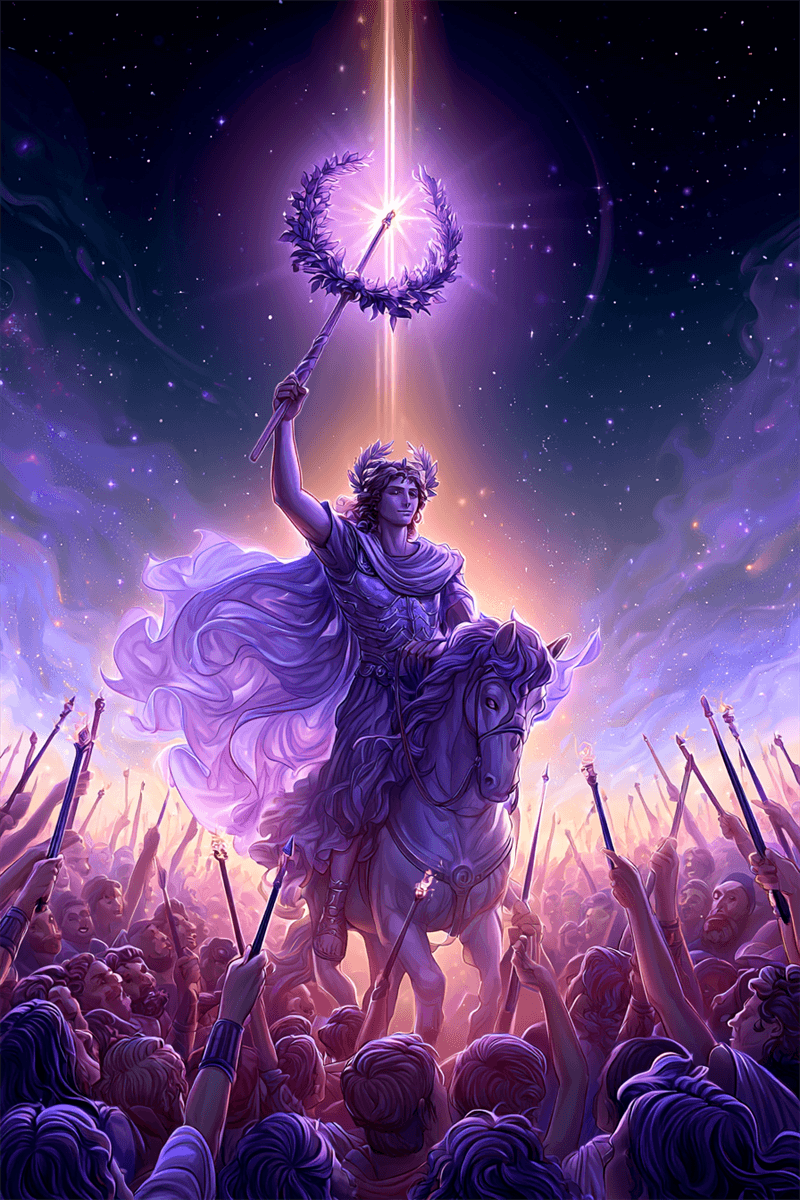
Pamela Colman Smith placed a laurel-crowned rider on a white horse at the center of the frame, a wand in his hand wreathed in a victory garland. Five other wands are held upright by foot-soldiers marching around him, and the figures move in procession through a cheering crowd. The rider sits erect and acknowledged — the general returning in triumph.
Key Symbolism
The laurel wreath on the rider's head and on the wand he carries are the classical crown of victory; the horse is the noble mount of one whose will has carried him above the common level. The five attendant wands are the community that has supported and now recognizes the achievement. The number six is balance and harmony, and the card captures the moment when effort, struggle, and recognition align into public victory.
Across Traditions
The Marseille Six is a balanced arrangement of batons with no scene. Smith's illustration made the metaphor of victory literal, drawing on the imagery of the Roman triumph. In the Thoth deck Crowley titles the card 'Victory', attributes it to Jupiter in Leo, and renders six wands radiating from a central point topped by a winged solar disk — the expansive, generous radiance of Jupiter amplifying the kingly fire of Leo.
Cultural Context
The Golden Dawn assigned the Six of Wands to Jupiter in Leo, the second decan of Leo — the king of planets in the king-of-beasts sign, the most regal astrological combination. The image of the laureled rider echoes the Roman triumph, the medieval joust, and the Renaissance ceremonial entry of a victorious general into his city. As the sixth card of the suit it marks the resolution of the Five's conflict into a recognized, harmonious achievement.