Eight of Cups
Discover the history and symbolism of the Eight of Cups tarot card, from Marseille origins to the Rider-Waite-Smith spiritual journey and Thoth tradition of indolence.
Etymology & Name
The card name follows the standard numerical convention: "Otto di Coppe" in Italian and "Huit de Coupes" in French, deriving from the Latin "octo." In the Golden Dawn system, the Eight of Cups was assigned to the first decan of Pisces, ruled by Saturn, giving it the Qabalistic title "Lord of Abandoned Success," which Crowley renamed "Indolence" in the Thoth Tarot. The number eight represents cycles, infinity, and the rhythm of withdrawal and return. In the Qabalistic Tree of Life, the eighth sphere is Hod, the sphere of intellect, form, and communication.
Early Imagery
In the Marseille tradition, the Eight of Cups displayed eight cup-shaped vessels arranged in a symmetrical pattern. The Noblet deck and Dodal deck showed eight cups in a balanced arrangement, often in two rows of four. No human figures or narrative scenes were depicted. The transition from Scorpio (cards 5-7) to Pisces (cards 8-10) marks a shift from intense, fixed emotional energy to mutable, dissolving, spiritual energy.
Rider-Waite-Smith Design
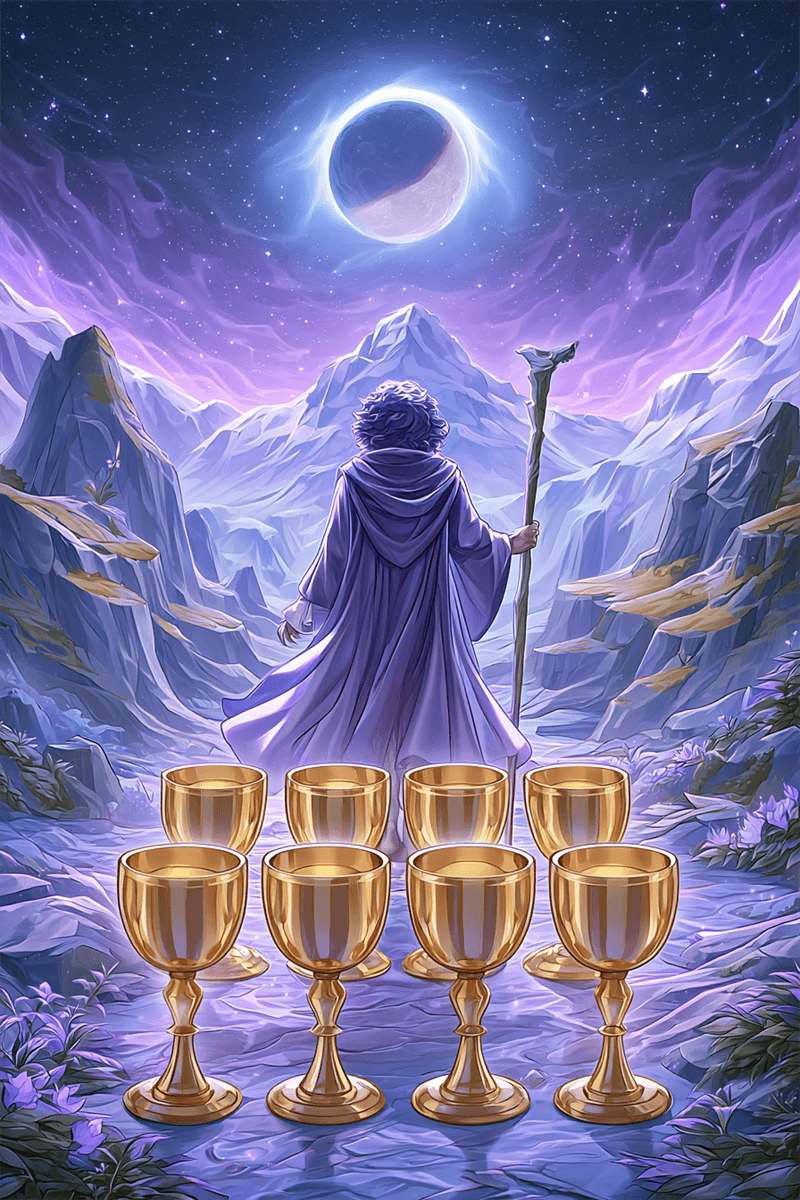
Pamela Colman Smith 1909 illustration creates a powerful narrative of spiritual quest and departure. A figure walks away from a carefully stacked arrangement of eight cups, leaving them behind on the ground. The figure carries a staff and walks uphill along a mountain path, moving toward a distant range of peaks. Above and behind the traveler, a large moon hangs low in the sky, its face visible, casting a pale, ethereal light over the landscape. Arthur Edward Waite described the card as representing "the decline of interest" and "the setting out on a journey."
Key Symbolism
The Eight of Cups is rich in symbolic meaning. The stacked cups left behind represent accumulated emotional achievements or attachments that are no longer fulfilling. The staff carried by the figure represents will and the power to journey. The mountain path symbolizes the difficult ascent of spiritual seeking. The moon overhead represents the unconscious, intuition, and the mysterious, cyclical nature of spiritual growth. Place notes that the departure motif echoes the biblical story of Abraham leaving his homeland, as well as the Buddhist legend of Siddhartha leaving his palace.
Across Traditions
The Marseille tradition presents eight chalices in a symmetrical pattern with no figures. Pamela Colman Smith 1909 RWS design introduced the iconic scene of a figure departing from stacked cups. The Thoth Tarot depicts eight lotus-cups arranged in a descending pattern, with dark, stagnant water barely flowing between them. Crowley titled the card "Indolence" and assigned it to Saturn in Pisces, emphasizing the lethargy, stagnation, and emotional heaviness of this combination.
Cultural Context
The Eight of Cups is assigned to the first decan of Pisces (0-10 degrees), ruled by Saturn. Helen Farley notes that the theme of spiritual departure and quest has deep roots in Western religious traditions, from the biblical exodus to the medieval pilgrim routes to the Grail quest of Arthurian legend. The moon as guide resonates with the Romantic movement fascination with lunar imagery.