Eight of Wands
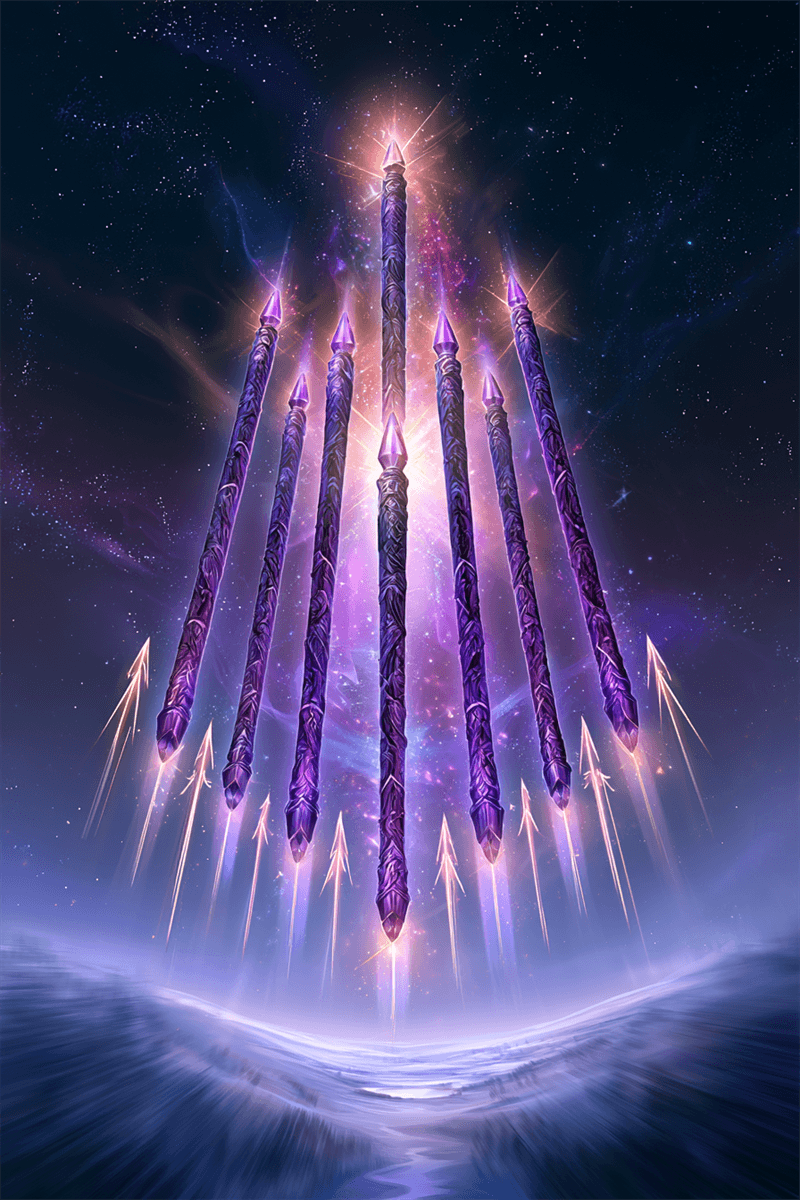
The Eight of Wands: from Marseille arranged batons to the Rider-Waite-Smith staves flying across the open sky — swiftness, communication, and the unhindered flight of intent.
Etymology & Name
The suit derives from the Italian 'Bastoni' (clubs, staves) and the French 'Bâtons' (batons). The eight of batons was 'Otto di Bastoni' or 'Huit de Bâtons' in the playing-card tradition, with no individual name. The divinatory meaning of swiftness and unhindered motion was assigned by nineteenth-century occultists, drawing on the airy quality of the number eight combined with the mutable fire of Sagittarius.
Early Imagery
In the Marseille tradition the Eight of Batons showed eight batons arranged in a symmetrical pattern — often a fan or a splayed array — with leafy ornament between them. The image was decorative and contained no figure, no landscape, no motion. Any sense of speed was carried by the suit of fire and the numerology of eight, not by the picture itself.
Rider-Waite-Smith Design
Pamela Colman Smith eliminated the human figure entirely: the card shows eight wands flying across a clear sky, their leafy tips angled downward as if descending toward a green landscape below. A river runs through the plain, and a small hill rises on the right, but no person appears. The image is pure motion — eight staves in mid-flight between sender and landing.
Key Symbolism
The eight wands in mid-air are intent in motion, the arrow released before it strikes. The downward angle of their flight implies a target already chosen and an arrival imminent. The absence of figures and the clear sky suggest that nothing now obstructs the message, the journey, or the project — the path is open and the velocity is constant. The number eight is the rhythm of cycles, and the card captures the moment when momentum has built and the work carries itself.
Across Traditions
The Marseille Eight is a decorative arrangement of batons with no scene. Smith's illustration is one of the most abstract in the deck, reducing the card to pure motion. In the Thoth deck Crowley titles the card 'Swiftness', attributes it to Mercury in Sagittarius, and renders seven wands (with an arrow) radiating from a central point against an electric, energy-filled background — the speed of mind joined to the reach of mutable fire.
Cultural Context
The Golden Dawn assigned the Eight of Wands to Mercury in Sagittarius, the first decan of Sagittarius — the planet of communication in the sign of the archer, of messages sent over long distances. The image of staves in flight echoes the arrow of Sagittarius itself, as well as the courier, the dispatch, and the telegraph. As the eighth card of the suit it captures the moment when the will, having established itself in the Seven, breaks free of opposition and travels at full speed.