Ace of Swords
Discover the history and symbolism of the Ace of Swords tarot card, from the Marseille pip to the Rider-Waite-Smith hand emerging from a cloud holding a sword.
Etymology & Name
The word "sword" derives from the Old English "sweord", tracing back to the Proto-Indo-European root "swer-" (to cut). In Italian the suit is "Spade" and in French "Épées", both denoting the noble weapon of the knightly class. The Ace (Asso/As) represents the seed or root of the suit, the purest expression of the element of Air.
Early Imagery
In the Marseille tradition the Ace of Swords was depicted as a single upright sword, often ornate, with a decorated hilt and blade. The Visconti-Sforza deck showed a more elaborate sword with floral ornamentation. The pip cards of the Marseille tradition were purely geometric arrangements of suit symbols, without figural scenes, leaving interpretation to the reader.
Rider-Waite-Smith Design
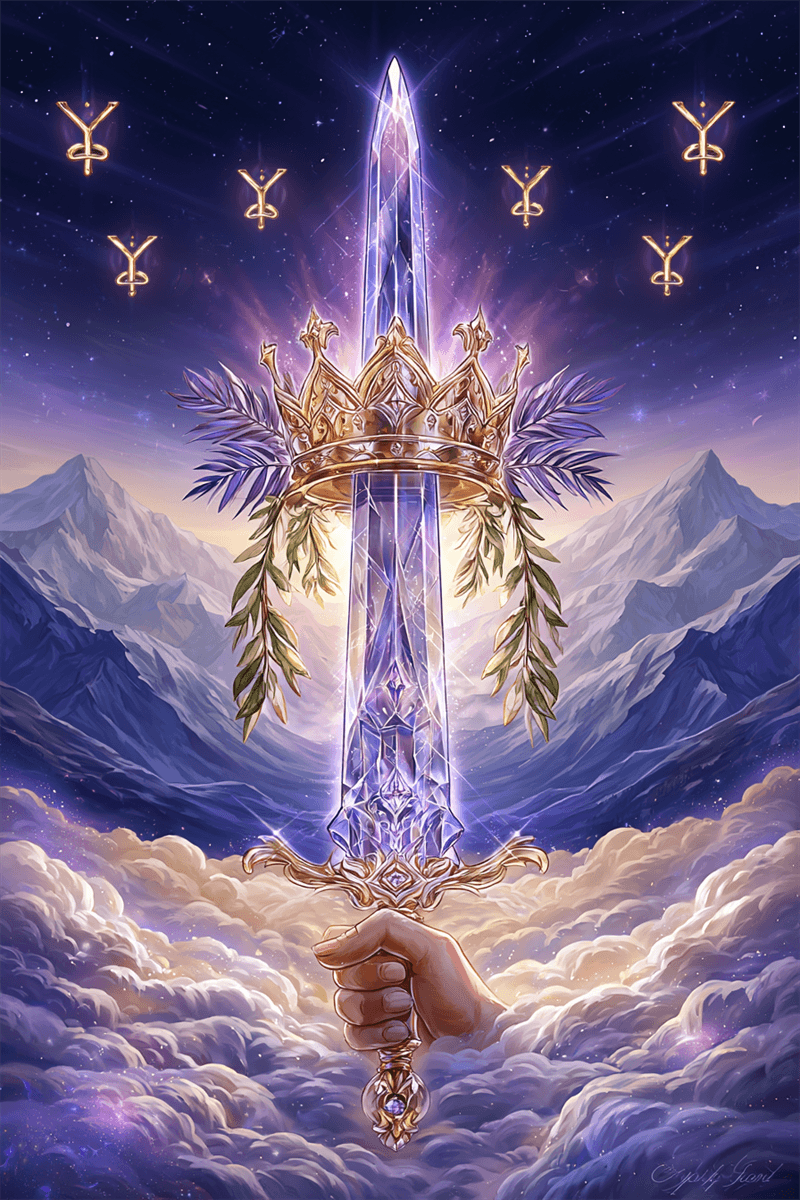
Pamela Colman Smith 1909 illustration transformed the pip into a powerful iconic image. A right hand emerges from a cloud, grasping an upright sword. At the tip of the sword rests a crown, from which hang palm and laurel branches. The crown signifies sovereignty of mind, while the palm (victory through struggle) and laurel (intellectual achievement) frame the sword as an instrument of discernment rather than destruction.
Key Symbolism
The Ace of Swords represents the moment of mental clarity, the flash of insight that cuts through confusion. The hand from the cloud is the divine or superconscious source of truth. The upright sword is the discriminating intellect, and the crown at its tip is the sovereignty that clear thinking confers. The palm and laurel signify that true victory comes through right use of the mind. As the root of Air, this card is the seed of all intellectual and communicative energy.
Across Traditions
The Marseille tradition shows a plain sword as a pip card. The RWS design introduced the hand-from-cloud, crown, and vegetation, drawing on Masonic and ceremonial magic symbolism. In the Thoth Tarot Crowley depicted the Ace of Swords as a sword with crystalline blade, surrounded by radiating light, emphasizing the purity of the intellectual principle. Crowley assigned it to the root of Air, and the sword is crowned with a laurel wreath in his design.
Cultural Context
The Ace of Swords is assigned to the element of Air in the Golden Dawn system, titled "Root of the Powers of Air" and attributed to Kether in Yetzirah (the World of Formation). It represents the intellect, reason, and communication. Helen Farley notes that the sword as a symbol of justice and discernment has roots in classical antiquity, from Athena to the sword of Damocles. In the context of the suit, this card represents the pure potential of the mind, the moment before thought becomes action, and the capacity for clear seeing.