Ace of Wands
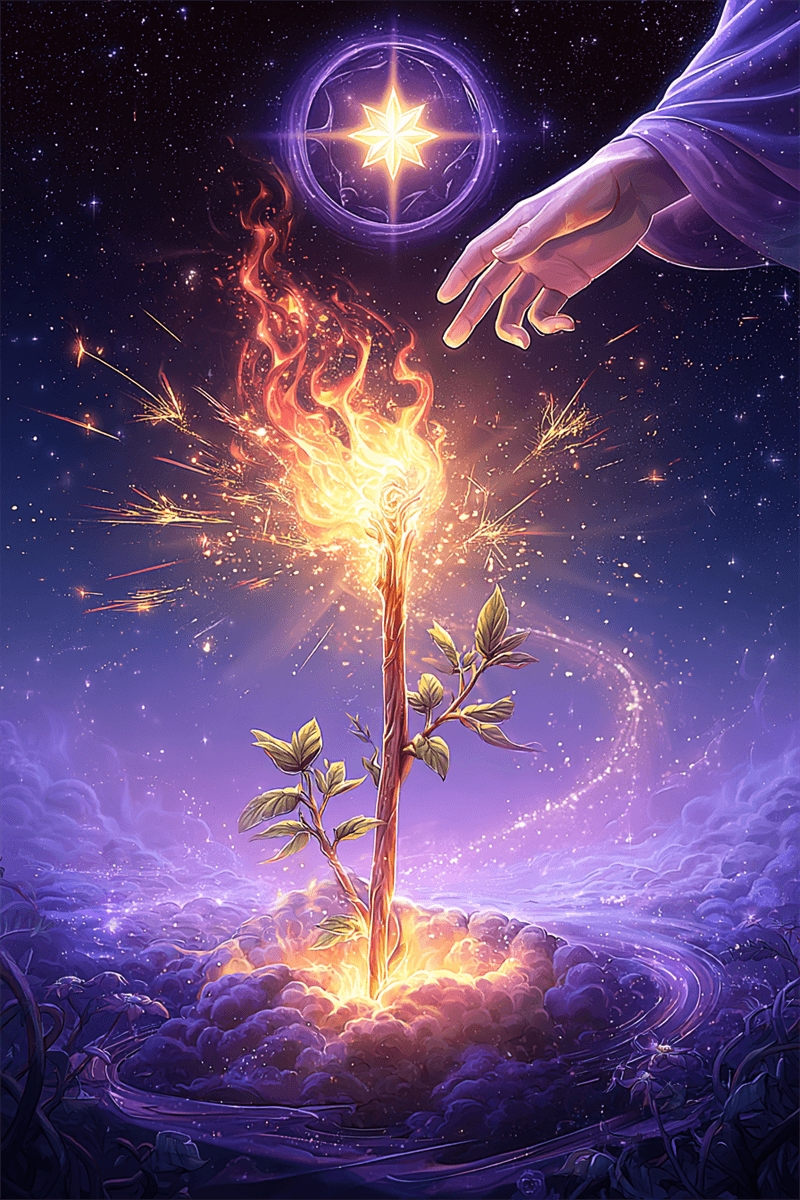
The Ace of Wands: from Marseille suit symbol to the Rider-Waite-Smith hand emerging from a cloud holding a flowering wand — fire, genesis, and the creative spark.
Etymology & Name
The suit derives from the Italian 'Bastoni' (clubs, staves) and the French 'Bâtons' (batons). The Ace — 'Asso' in Italian, 'As' in French — marked the lowest suit value in the playing-card tradition, but in tarot divination it became the seed or root of the suit. For Wands that root is Fire, the suit of will, vitality, and creative initiative.
Early Imagery
In the Marseille tradition the Ace of Batons showed a single decorated baton held vertically, often with leafy tendrils curling from its shaft and a small hand or flourish at the top. Like all Marseille Minor Arcana, it carried no scenic illustration — only the suit symbol arranged in a decorative pattern, sometimes held by a disembodied hand. The numbered small cards were essentially ornamental arrangements of the baton sign.
Rider-Waite-Smith Design
Pamela Colman Smith's 1909 illustration shows a right hand emerging from a grey cloud at the right edge of the frame, grasping a living wand whose shaft has sprouted green leaves and whose tip bursts into a small tree of leaves. A castle-topped hill rises in the distance beneath a clear sky. The image transforms the static baton of the Marseille deck into a literal flowering — fire made generative.
Key Symbolism
The hand from the cloud is the divine or creative gift descending into the material world; the wand in leaf is the spark of life taking root. The yod-shaped leaves at the tip evoke the Hebrew letter Yod, the seed of all other letters in Kabbalah. The castle on the hill suggests the future that this initial creative act can build toward, while the empty landscape holds space for what has not yet been made.
Across Traditions
The Marseille Ace is purely decorative — a single baton with ornament. Waite and Smith gave the card its iconic scenic image, framing the suit's element of Fire as generative power. In the Thoth deck Crowley titles the card 'The Root of the Powers of Fire' and replaces the leaves with a wand crowned by a winged solar globe and tongues of flame, leaning on Kabbalistic and astrological attributions to Aries.
Cultural Context
The suit of Wands corresponds to the element of Fire and, in the Golden Dawn system, to the three fire signs of the zodiac — Aries, Leo, and Sagittarius — which the small cards of the suit subdivide. The Ace gathers all of these into a single point of origin. As the 'root' card of the suit, the Ace of Wands expresses the moment when will, desire, or creative impulse first becomes visible — the kindling before the flame.