The Magician
The Magician tarot history: its origin as Il Bagatto, a street conjurer in early Italian decks, and its Rider-Waite-Smith transformation into the master of the four elements.
Etymology & Name
The Italian 'Il Bagatto' (also 'Bagattino') originally meant a small coin or trifle, and by extension a sleight-of-hand trick; the French 'Le Bateleur' means a street performer or mountebank. The card's earliest identity was therefore a humble juggler, not a magus. The elevation to 'The Magician' was largely the work of nineteenth-century occultists, beginning with Éliphas Lévi.
Early Imagery
In the Visconti-Sforza and Marseille decks the figure stands behind a table displaying cups, knives, balls, and dice — the props of a fairground conjurer. He is a craftsman of small wonders, socially marginal and earthbound. There is no infinity symbol, no gesture to heaven and earth; those are later additions.
Rider-Waite-Smith Design
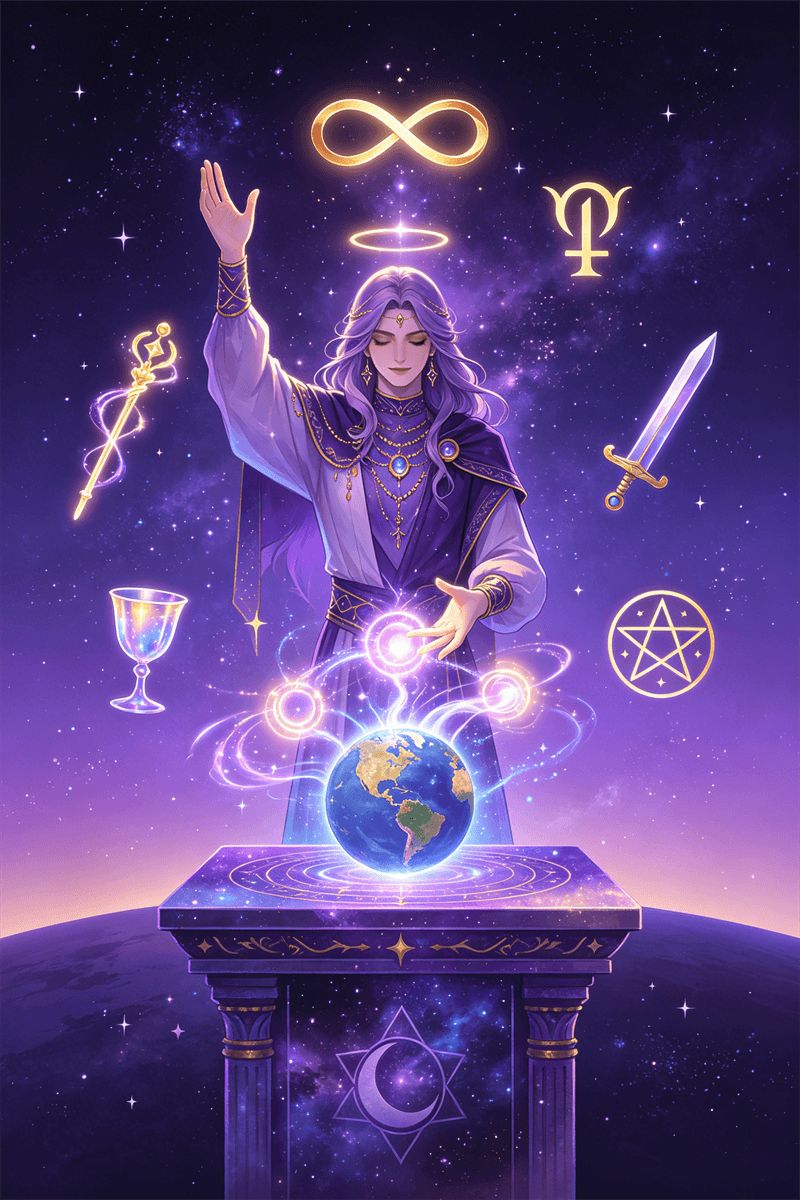
Smith transformed the mountebank into a commanding figure who raises a wand to the sky while pointing to the ground, enacting the Hermetic maxim 'as above, so below'. On the table lie the four suit tools — cup, sword, wand, and pentacle — signifying mastery over the elements. A lemniscate (the infinity sign) floats above his head, and a garden of red roses and white lilies encircles him, uniting desire and purity.
Key Symbolism
The infinity symbol denotes limitless spiritual power; the four tools represent the complete toolkit of emotion, intellect, passion, and matter. The upward and downward gestures channel divine energy into the material world, while the red and white flowers reconcile desire with purity. The Magician is will made effective — the first act of creation that follows the Fool's potential.
Across Traditions
The Marseille Bateleur is a common trickster with no overt occult meaning. Lévi first recast him as a magus; Waite and Smith gave that idea its definitive image. In the Thoth deck Crowley names him 'The Magus' and assigns him to Mercury, depicting pure will and communication through a complex assembly of symbols, swords, and apes.
Cultural Context
The Magician reflects the Renaissance ideal of the 'magus' — the human being as microcosm, able to mediate between heaven and earth. He also carries the ambivalent reputation of the trickster, the figure whose skill can create or deceive. As trump number 1 he is the first manifestation of the Fool's zero, the beginning of conscious action.