The High Priestess
The High Priestess tarot history: from La Papessa in early Italian decks to the Rider-Waite-Smith guardian of the subconscious between Boaz and Jachin.
Etymology & Name
The Italian 'La Papessa' means 'the female pope'. The figure has often been linked to the medieval legend of Pope Joan, a woman said to have reigned as pope undiscovered until she gave birth in a procession. Whether or not the legend is the direct source, the image clearly denotes a female religious authority standing outside the ordinary male hierarchy.
Early Imagery
From the Visconti-Sforza deck onward, La Papessa appears as a woman wearing a triple tiara, holding a book or staff, seated in calm authority. The Marseille tradition keeps her frontal and static, an icon rather than a narrative. She was likely read as an allegory of Faith or of the Church, not yet as an esoteric priestess.
Rider-Waite-Smith Design
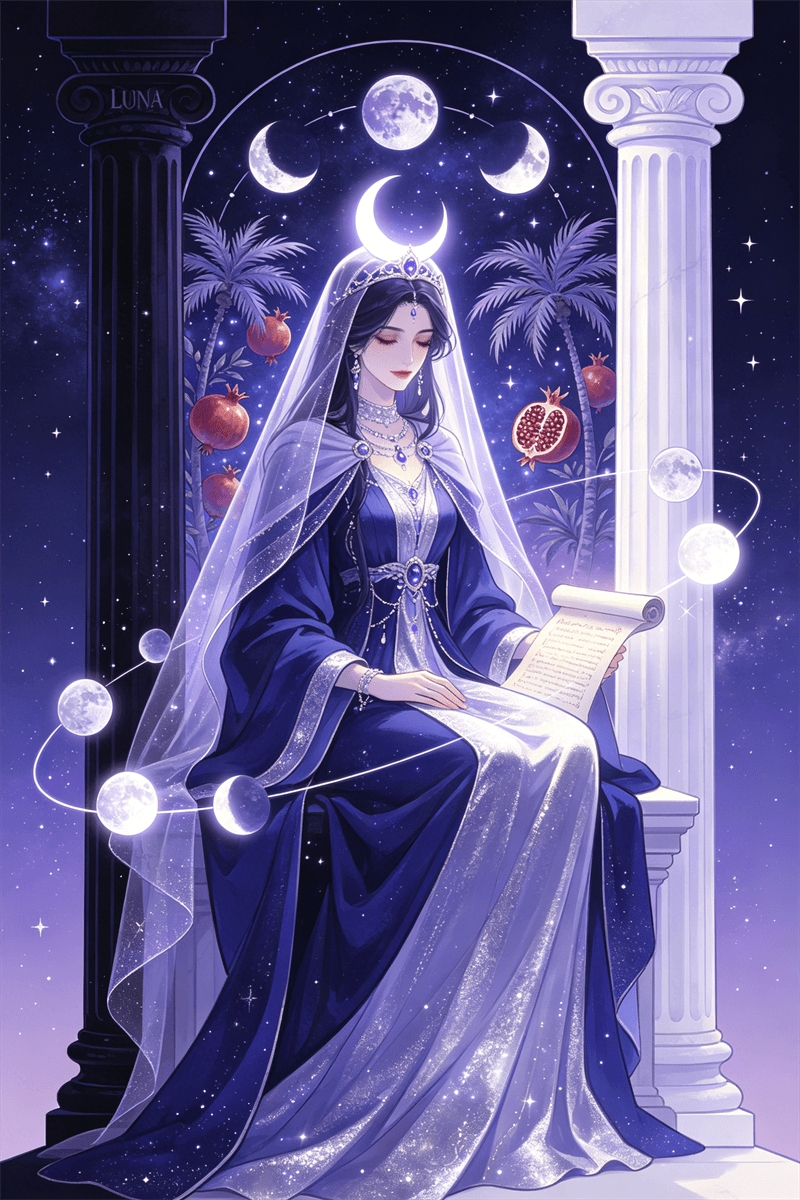
Smith reshaped her into the veiled guardian of hidden knowledge. She sits between two pillars — black (B, Boaz) and white (J, Jachin), the columns of Solomon's Temple — behind a curtain embroidered with pomegranates, a symbol of the Kabbalistic Tree of Life. A crescent moon lies at her feet, she wears a crown of three lunar phases, and a half-open scroll marked 'TORA' rests in her lap.
Key Symbolism
The two pillars represent duality — light and dark, conscious and unconscious. The curtain and pomegranates conceal the hidden source of wisdom; the lunar crown marks her domain as intuition, dream, and the subconscious. The scroll of Torah signifies divine law accessible only to the patient seeker, and the moon beneath her feet anchors her in the tides of the inner world.
Across Traditions
The Marseille Papesse is a sober icon of female spiritual authority. Waite, drawing on Golden Dawn correspondences, made her the keeper of esoteric mystery. In the Thoth deck Crowley names her 'Priestess', assigns her to the Moon, and arms her with a bow, emphasizing the active, penetrating quality of lunar intuition.
Cultural Context
Beyond Pope Joan, the High Priestess echoes Isis, Persephone, and the moon goddess Diana. In Jungian psychology she represents the unconscious and the archetype of the wise woman. As the third figure in the trump sequence she introduces the dimension of inwardness, the silent counterweight to the Magician's outward action.