The Empress
The Empress tarot history: her Italian origin as L'Imperatrice, her pairing with the Emperor, and her Rider-Waite-Smith form as the fertile Earth Mother under twelve stars.
Etymology & Name
The name descends from the Latin 'imperatrix', the feminine of 'imperator' (commander, emperor). In the early decks she is simply the female sovereign, paired with the Emperor as the two highest secular authorities of the trump sequence.
Early Imagery
In the Visconti-Sforza deck she is a noblewoman bearing a heraldic shield; the Marseille tradition seats her on a throne with scepter and shield, often crowned with twelve stars. She is the imperial consort, a figure of worldly authority and dynastic fertility, not yet a nature goddess.
Rider-Waite-Smith Design
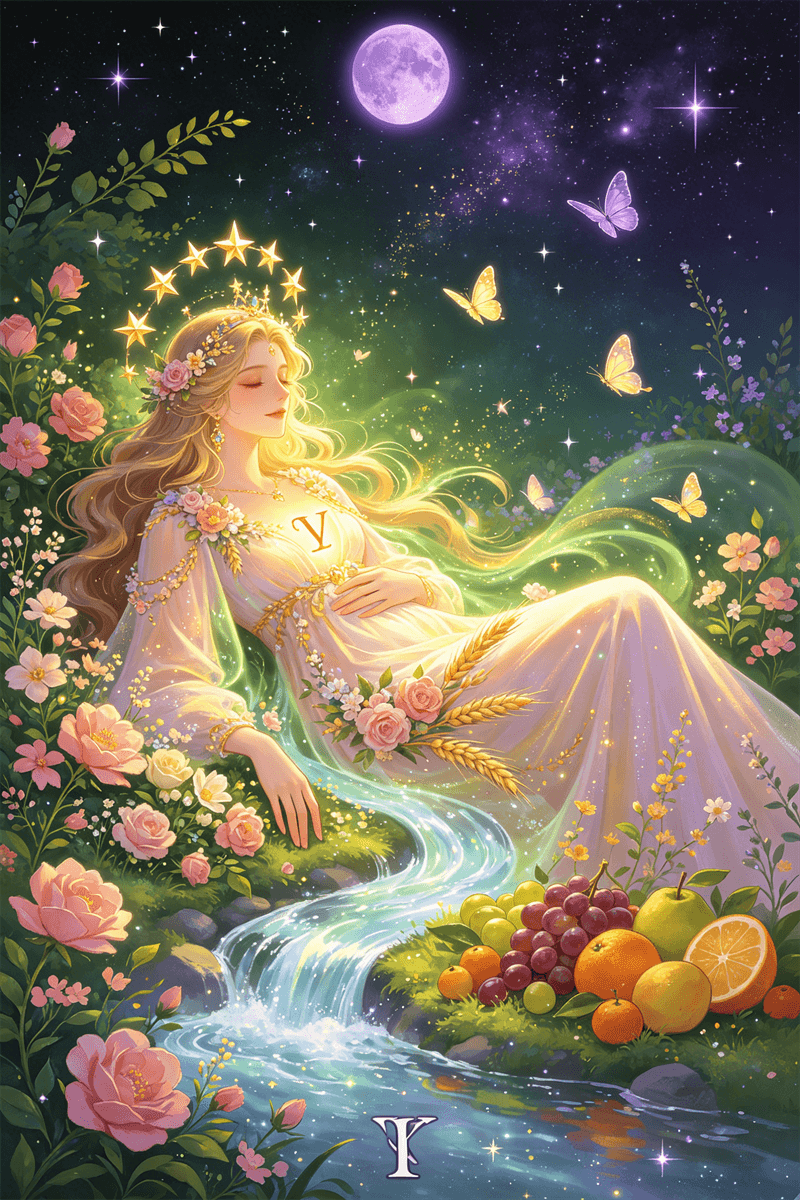
Smith moved her outdoors into a lush garden of ripe wheat and flowing water. She wears a crown of twelve stars (the zodiac), her chair is upholstered with Venus symbols, and she holds a shield bearing the glyph of Venus (♀). Her robe is patterned with pomegranates, signifying fertility and sacred feminine knowledge.
Key Symbolism
The twelve-star crown links her to the cycles of the zodiac and the rhythms of nature; the Venus symbol governs love, beauty, and sensuality; the wheat and water denote abundance and the flow of creative life. The pomegranates echo the High Priestess but here are overt: she is the fertile, generative mother rather than the veiled virgin.
Across Traditions
The Marseille Empress is a secular sovereign. Waite amplified her into the Great Mother and the archetype of feminine creativity. In the Thoth deck Crowley surrounds her with lotuses, bees, moons, and flowing fabric, emphasizing the dynamic current of creation and attributing her to Venus.
Cultural Context
She is the Great Mother in many guises — Demeter, Isis, Venus, and the Christian Madonna. In Jungian terms she represents the Mother archetype: nurture, abundance, and the creative power of nature. Paired with the Emperor, she embodies the receptive, generative pole of authority.