The Emperor
The Emperor tarot history: from L'Imperatore in Italian courts to the Rider-Waite-Smith sovereign on a ram-headed throne, embodiment of structure and worldly order.
Etymology & Name
From the Latin 'imperator', originally a military commander acclaimed by his troops and later the supreme Roman ruler. The card names the highest male secular authority, the mirror of the Empress.
Early Imagery
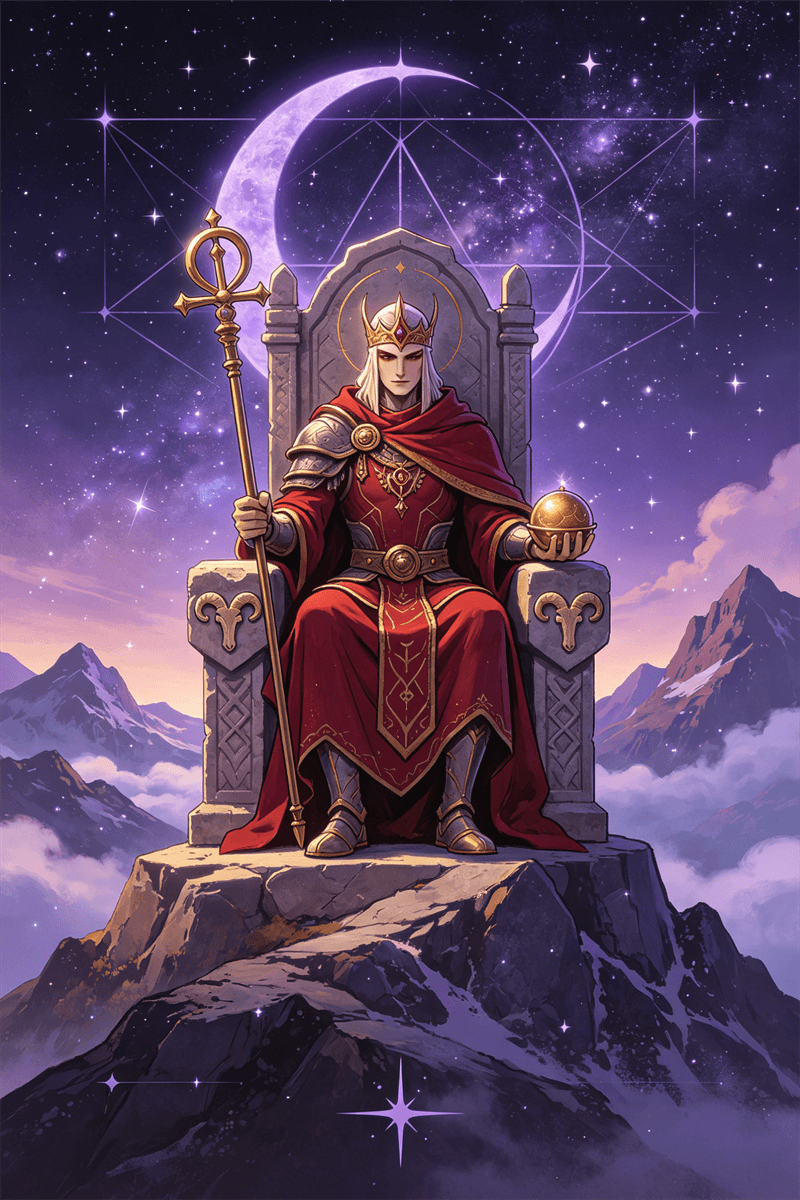
From the earliest decks the Emperor appears as a crowned man seated on a throne, holding a scepter and orb, usually shown in profile. He is the worldly sovereign, the counterpart to the spiritual authority of the Pope. The Marseille tradition keeps him armored and martial.
Rider-Waite-Smith Design
Smith seated him on a stone throne whose back is carved with ram heads — the sign of Aries — and gave him a beard, armor, and a scepter topped with an ankh and globe. The barren, rocky landscape behind him underscores his domain of structure, defense, and worldly order.
Key Symbolism
The rams denote Aries and assertive leadership; the armor and stone throne signify defense, stability, and the hard framework of law. The scepter and orb are the emblems of earthly rule. Where the Empress is growth and flow, the Emperor is boundary, structure, and the father principle that gives form.
Across Traditions
The Marseille Emperor is a martial sovereign bearing a shield. Waite emphasized him as the principle of order and paternal authority, attributing him to Aries. Crowley retained the Aries attribution in the Thoth deck, dressing the Emperor in red and gold and depicting ram horns on the throne to express the fiery sovereignty of Aries.
Cultural Context
The Emperor embodies the archetypal Father and the Roman imperium: law, hierarchy, and the structuring power that makes civilization possible. Paired with the Empress, he represents the active, form-giving pole of authority — the framework within which her fertility can grow.