King of Cups
Discover the history and symbolism of the King of Cups tarot card, from the Marseille Roi to the Rider-Waite-Smith sea throne design and Thoth tradition.
Etymology & Name
The King was called "Re" in Italian and "Roi" in French, both deriving from the Latin "rex" (king). In the Golden Dawn system, the King was assigned the element of Fire within the suit, making the King of Cups the "Fire of Water." Robert Place notes that the King represents the authoritative, governing, and balancing aspect of the suit energy. The King of Cups was associated with the zodiac sign Pisces (mutable water), ruling the 30-degree arc from 20 degrees Aquarius to 20 degrees Pisces.
Early Imagery
In the Marseille tradition, the King of Cups (Roi de Coupes) was depicted as a seated male figure holding a cup. The Noblet deck and Dodal deck showed the Roi as a bearded man in regal robes and crown, seated on a throne. The court card figures were the most elaborately rendered of the minor arcana, with careful attention to the decoration of the throne, the King robes, and the ornaments of his crown. Dummett notes that the King ranked highest in the court hierarchy, representing the mature masculine authority of the court.
Rider-Waite-Smith Design
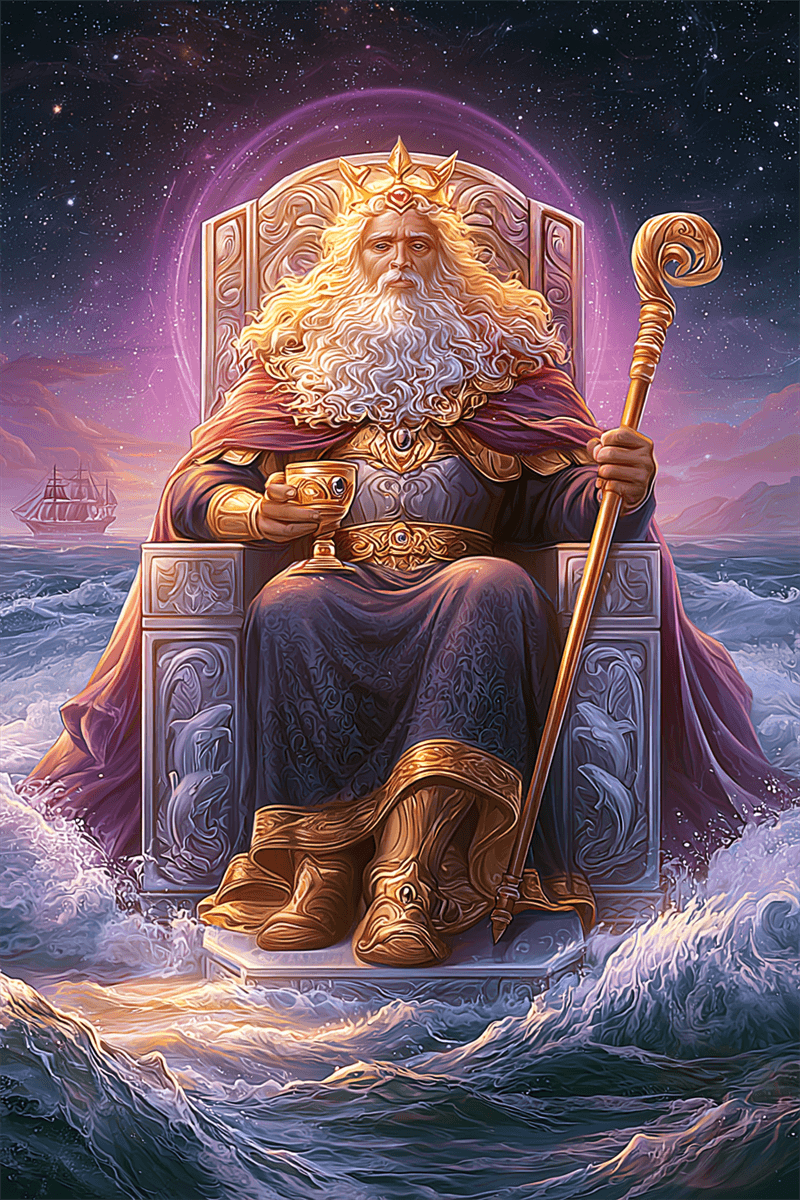
Pamela Colman Smith 1909 illustration creates a portrait of emotional mastery amid turbulence. The King sits on a throne that appears to float on the sea, with waves visible around its base. Fish and dolphins are visible in the water around the throne, and a ship sails in the distant background. The King holds a cup in his right hand and a scepter in his left. His beard and mature features suggest wisdom and authority. Arthur Edward Waite described the card as representing a man of "intellect" and "consideration." The floating throne is one of Smith most striking additions: the King seat of power rests not on solid ground but on the ever-moving sea.
Key Symbolism
The King of Cups is built around the archetype of the emotionally sovereign ruler. The throne floating on the sea represents the mastery of emotion, the ability to maintain composure amid the turbulent waters of feeling. Place notes that the fish and dolphins surrounding the throne represent the inhabitants of the unconscious. In classical and medieval symbolism, the dolphin was associated with the soul, with guidance, and with Christ in early Christian art. The cup held by the King represents his emotional authority. The scepter represents his sovereign power. As the "Fire of Water," the King represents the active mastery of emotion.
Across Traditions
The Marseille tradition presents the King as a seated, bearded figure holding a cup, a conventional image of sovereignty. Pamela Colman Smith 1909 RWS design introduced the sea-borne throne surrounded by fish and dolphins. The Thoth Tarot depicts the "Knight of Cups" as a figure in a chariot drawn by an eagle, holding a lotus and a cup. Crowley described the Knight as representing the "fiery part of water," the active, governing dimension of the emotional realm. The eagle drawing the chariot represents the spiritual and contemplative dimension.
Cultural Context
The King of Cups represents the "Fire of Water" in the Golden Dawn elemental system, associated with the mutable water sign Pisces. Helen Farley notes that the archetype of the wise king of the waters has deep roots in Western mythological traditions. The figure of Neptune or Poseidon provides a classical antecedent. The image of the throne floating on water resonates with the biblical image of God spirit moving over the waters of creation. In the context of the suit of Cups, the King represents the culmination of the suit court hierarchy, the mature, integrated expression of the water element, where emotional depth is balanced with active authority.