King of Wands
The King of Wands: from the court cards of Marseille to the Rider-Waite-Smith enthroned king with his salamanders — sovereignty, mastery, and the will that rules its own fire.
Etymology & Name
The suit derives from the Italian 'Bastoni' (clubs, staves) and the French 'Bâtons' (batons). The court cards received individual ranks in the playing-card tradition, and the highest-ranking figure was the 'Re' (Italian) or 'Roi' (French) — the king. The King of Wands is the sovereign masculine of the fire suit — the will that has reached full authority and rules the realm its fire has built.
Early Imagery
In the Marseille tradition the Roi de Bâtons was an enthroned mature man in Renaissance dress, holding a flowering baton as his scepter. The image was scenic but static — a seated king rather than a narrative character. His rank was marked by his throne, his beard, and his crown, and his suit by the baton he held as a sign of office.
Rider-Waite-Smith Design
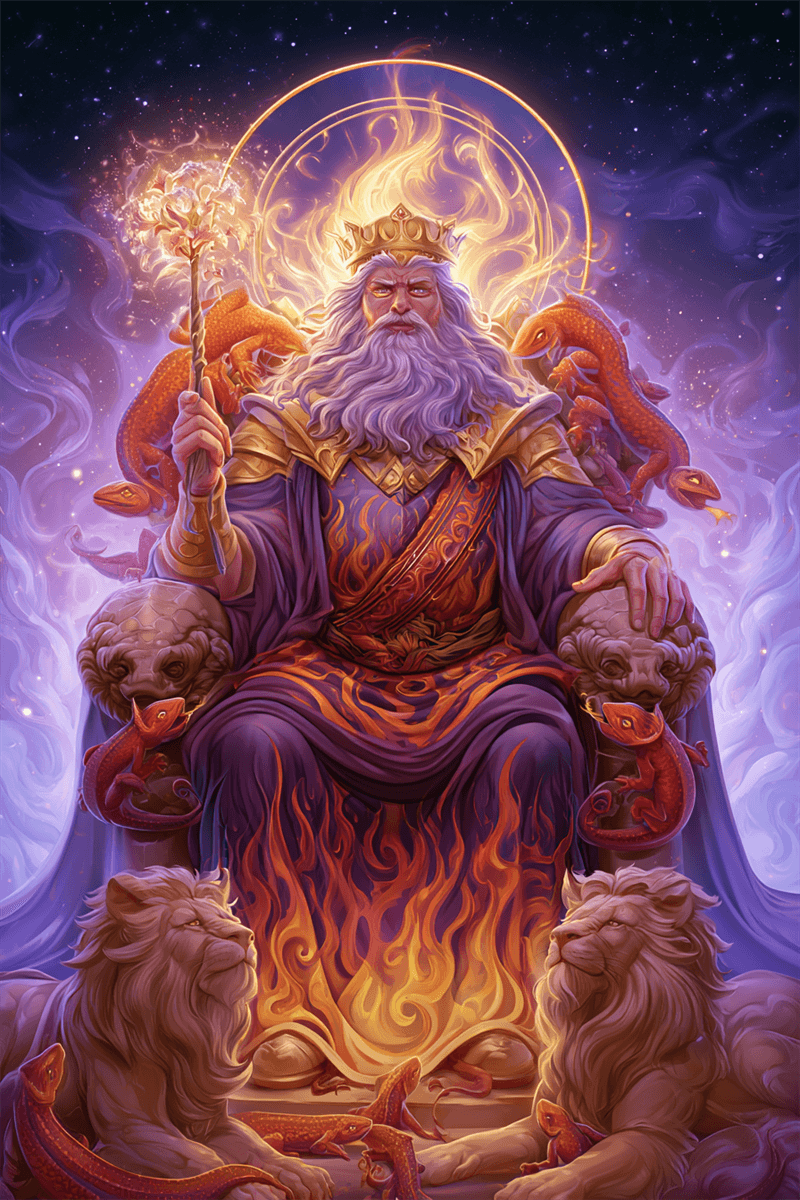
Pamela Colman Smith placed a king on a throne decorated with salamanders and lions, holding a flowering wand in his right hand and a small shield or armrest in his left. A salamander biting its own tail curls at the throne's base, his crown is golden, and his red and yellow robes blaze against a desert landscape with pyramidal hills. The image is one of settled, fiery authority.
Key Symbolism
The salamanders are the elemental fire-spirits of Paracelsus, and their presence marks the throne as the seat of fire itself; the lions again invoke the fire sign Leo. The flowering wand held as a scepter is the will made official — the suit's spark now the instrument of rule. The tail-biting salamander at the base is the alchemical ouroboros, the eternal cycle of fire sustaining itself. The card captures fire at the height of its authority — the will that rules rather than pursues or attracts.
Across Traditions
The Marseille Roi is an enthroned court figure with no narrative. Smith's illustration gave him the fiery, salamander-decorated throne that has defined the card ever since. In the Thoth deck Crowley shifts the title: the Thoth 'Knight of Wands' corresponds to the RWS King, and is shown mounted on a black horse armed with a flame-tipped wand — the pure, active fire of the suit embodied in a single sovereign figure. Crowley associated the Knight with the zodiac sign Sagittarius.
Cultural Context
The King of Wands represents the 'Fire of Fire' in the Golden Dawn elemental system. The suit of Wands corresponds to the element of Fire, and the King - as the enthroned sovereign - represents the suit at the height of its authority: the will that rules what it has built. The figure of the enthroned king reflects the medieval and Renaissance sovereign, the ruler whose authority is exercised through law and presence rather than action. As the fourth and final court card of the suit he marks the moment when the will has reached full mastery — the fire that rules the realm its own spark has built.