Knight of Cups
Learn about the history and symbolism of the Knight of Cups tarot card, from the Marseille Cavalier to the Rider-Waite-Smith grail knight and Thoth tradition.
Etymology & Name
The Knight was historically called "Cavallo" (horse) in Italian and "Cavalier" (horseman) in French, both deriving from the Late Latin "caballus" (horse), which also gives English "cavalry" and "chivalry." In the Golden Dawn system, the Knight was assigned the element of Air within the suit, making the Knight of Cups the "Air of Water." Robert Place notes that the mounted court card represents the active, dynamic expression of the suit energy. The Knight of Cups was associated with the zodiac sign Cancer (cardinal water).
Early Imagery
In the Marseille tradition, the Knight of Cups (Cavalier de Coupes) was depicted as a mounted figure, a young man on horseback holding or carrying a cup. The Noblet deck and Dodal deck showed the Cavalier as an armored rider. The court card figures in Marseille decks were more elaborately rendered than the numbered cards, with attention to costume, armor, and the horse harness. Dummett notes that the Cavalier ranked above the Valet and below the Queen and King, representing a young warrior or messenger, a figure of action and movement.
Rider-Waite-Smith Design
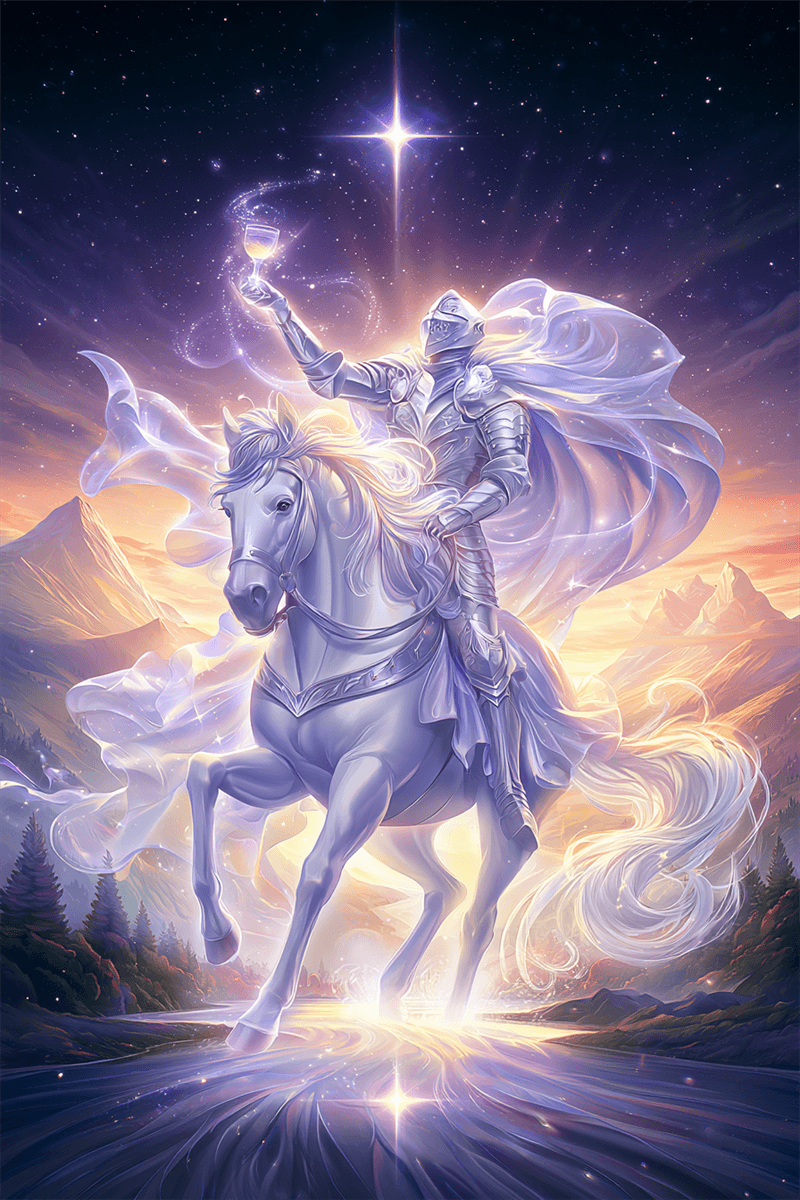
Pamela Colman Smith 1909 illustration creates a romantic, dreamlike portrait of the questing idealist. A knight in full armor rides a white horse at a slow, measured pace. He holds a golden cup aloft in his right hand, raised as if in offering or dedication. His helmet bears wings, small, feathered wings that suggest the speed and lightness of Mercury or Hermes. Arthur Edward Waite described the character as representing "arrival and advance," with the knight coming as "a messenger of love." The winged helmet draws on classical imagery of Hermes, connecting the knight to the tradition of the divine messenger.
Key Symbolism
The Knight of Cups is built around the archetype of the romantic quester and messenger. The white horse is a powerful symbol of purity and spiritual power. The winged helmet draws directly on classical imagery of Hermes, suggesting that this knight is a bearer of messages and a mediator between the conscious and unconscious realms. The cup held aloft represents the object of the quest, the Grail. Place notes that the slow, measured pace of the horse distinguishes this knight from more impulsive knights. The armor represents protection and the knightly code, but also the vulnerability that lies beneath.
Across Traditions
The Marseille tradition presents the Knight of Cups as a mounted figure holding a cup, a relatively simple equestrian design. Pamela Colman Smith 1909 RWS design introduced the winged-helmeted knight on a white horse. The Thoth Tarot depicts the Prince with a peacock, the bird sacred to Hera and a symbol of beauty and the all-seeing eye of the cosmos. Crowley described the Prince as representing the "airy part of water," the active, questing energy of the emotional realm. The peacock imagery reflects the sensuous, beautiful quality of this combination.
Cultural Context
The Knight of Cups represents the "Air of Water" in the Golden Dawn elemental system, associated with the cardinal water sign Cancer. Helen Farley notes that the figure of the questing knight has deep roots in medieval romance literature, particularly the Arthurian cycle of Grail romances. The Grail Knight represented the ideal of the pure-hearted seeker. This literary tradition was enormously popular in the Victorian era through the works of Tennyson and the Pre-Raphaelite painters.