Knight of Wands
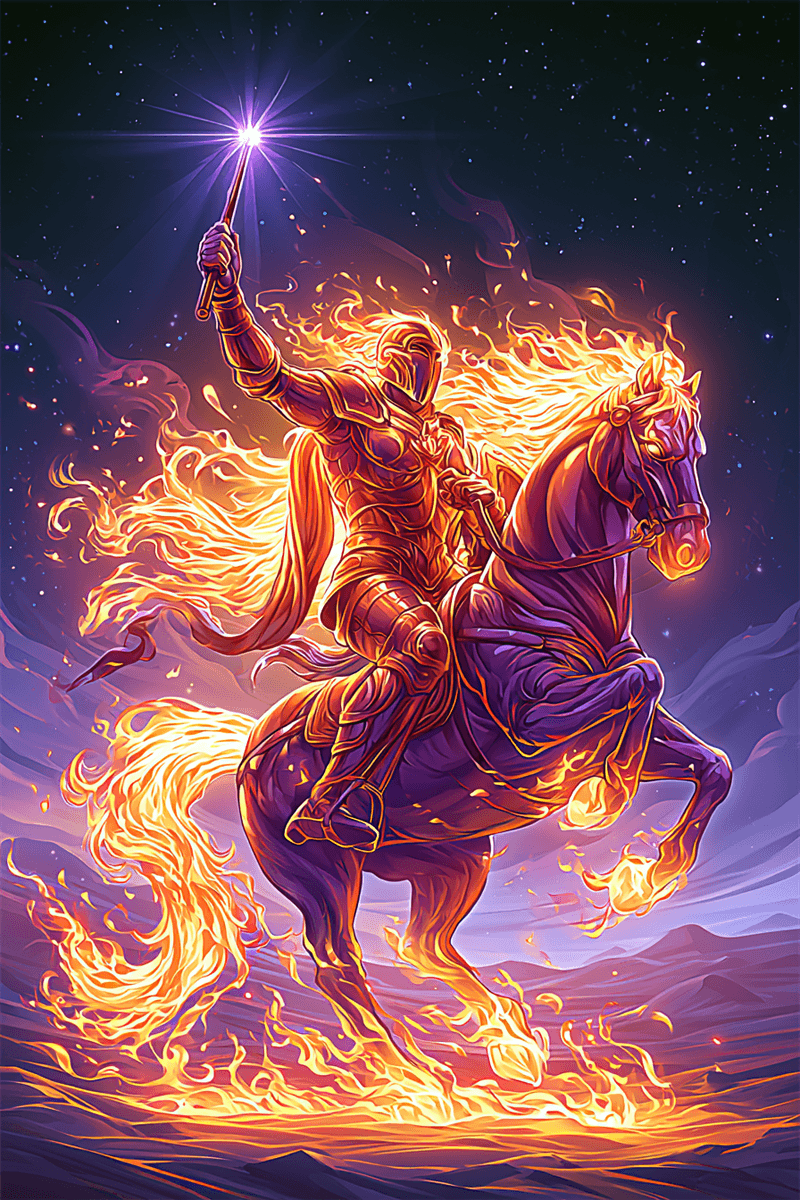
The Knight of Wands: from the court cards of Marseille to the Rider-Waite-Smith charging horseman — the quest, the impetuous will, and fire in active motion.
Etymology & Name
The suit derives from the Italian 'Bastoni' (clubs, staves) and the French 'Bâtons' (batons). The court cards received individual ranks in the playing-card tradition, and the highest-ranking male figure (below the King) was the 'Cavallo' (Italian) or 'Chevalier' (French) — the horseman or knight. The Knight of Wands is the active figure of the fire suit — the will in pursuit of its quest.
Early Imagery
In the Marseille tradition the Cavallo de Bastoni was a mounted figure in Renaissance dress, holding his baton at the ready. The horse was usually drawn in profile, the rider turning to face the viewer, and the image was scenic but generic — a court horseman, not a character with a story. The Marseille deck's three male court figures (Valet, Cavallo, Re) were distinguished by rank and posture more than by narrative.
Rider-Waite-Smith Design
Pamela Colman Smith placed a knight in full Renaissance armor on a rearing horse, holding a wand upright in his right hand. His horse gallops across a desert plain dotted with small pyramids, and the rider's red plume, yellow sleeves, and tunic all stream behind him as if driven by his own forward motion. The image is one of the most dynamic in the deck — pure charge.
Key Symbolism
The rearing horse is the impetuous forward motion of the fire suit embodied in a living mount; the wand raised upright is the will held high as a banner. The desert landscape and the pyramids recall the original Egyptomania of Court de Gébelin, but more importantly they mark the alien ground across which the quest rides. The streaming plumes and sleeves are the visible trail of speed. The card captures fire in active pursuit — the quest before it has been tested by experience.
Across Traditions
The Marseille Cavallo is a mounted court figure with no narrative. Smith's illustration transformed him into a charging quester, the most kinetic image in the suit. In the Thoth deck Crowley renames the RWS Knight as the 'Prince of the Chariot of Fire', and shifts the title of 'Knight' to the figure corresponding to the RWS King; the Thoth Prince is shown in a chariot drawn by a lion, embodying the active fire of Aries.
Cultural Context
The Knight of Wands represents the 'Air of Fire' in the Golden Dawn elemental system. The suit of Wands corresponds to the element of Fire, and the Knight - as the active questing figure - represents the suit in motion: the will pursuing its quest. The figure of the mounted knight reflects the late-medieval chevalier, the questing noble of Arthurian romance and the chivalric tradition. As the second court card of the suit it marks the moment when the Page's initial spark has become active pursuit — fire in motion, the quest in full career.