Queen of Cups
Explore the history and symbolism of the Queen of Cups tarot card, from the Marseille Reine to the Rider-Waite-Smith closed cup design and Thoth tradition.
Etymology & Name
The Queen was called "Regina" in Italian and "Reine" in French, both deriving from the Latin "regina" (queen). In the Golden Dawn system, the Queen was assigned the element of Water within the suit, making the Queen of Cups the "Water of Water," a double water influence representing the purest, most concentrated expression of the water element. Robert Place notes that the Queen represents the receptive, sustaining, and nurturing aspect of the suit energy. The Queen of Cups was associated with the zodiac sign Scorpio (fixed water).
Early Imagery
In the Marseille tradition, the Queen of Cups (Reine de Coupes) was depicted as a seated female figure holding a cup. The Noblet deck and Dodal deck showed the Reine as a woman in Renaissance-style dress, seated on a throne. The cup held by the Queen was often depicted as closed or covered, a detail that would later take on symbolic significance. Dummett notes that the Queen ranked above the Cavalier and Valet but below the King, representing the mature feminine authority of the court.
Rider-Waite-Smith Design
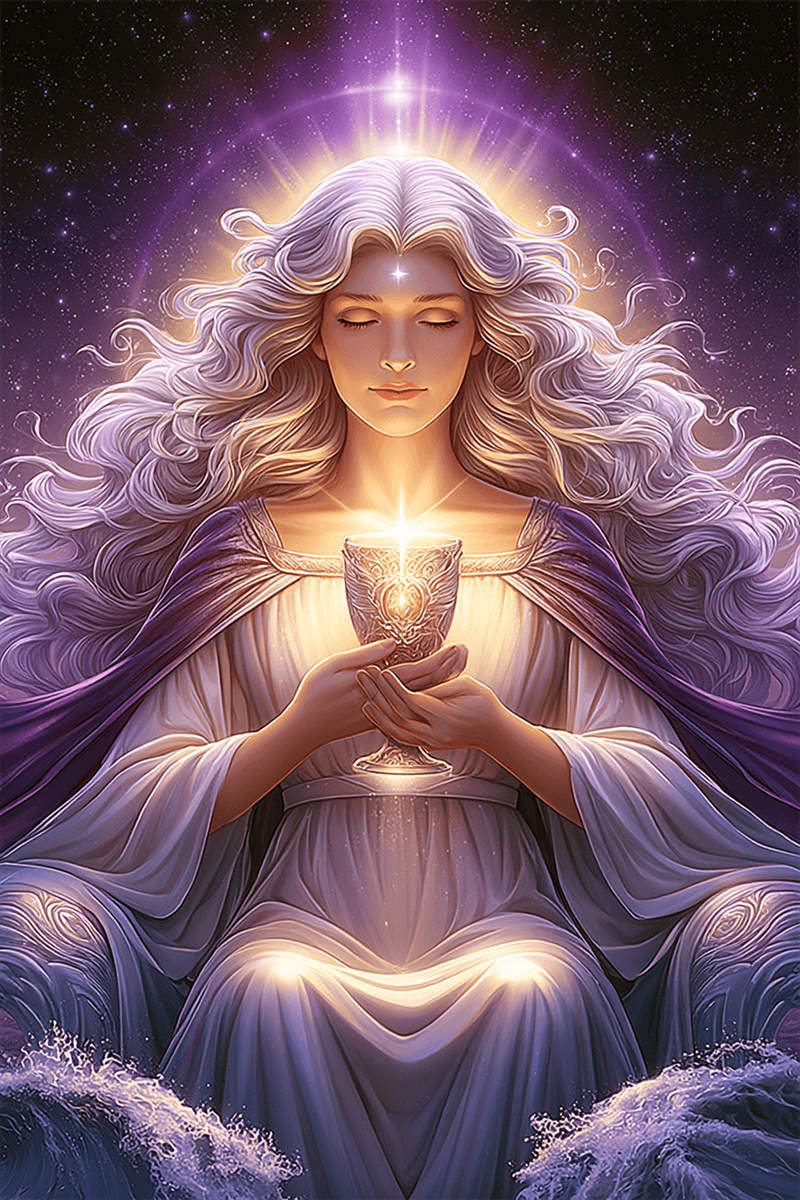
Pamela Colman Smith 1909 illustration creates a powerful portrait of emotional depth and contained intuition. The Queen sits on an ornate throne placed at the edge of the sea, her feet almost touching the water. She holds a cup that is closed or covered, its lid decorated with angel-wing-shaped handles. The throne is carved with marine imagery: shells, fish, and waves. The sea stretches behind her, with a ship visible in the distance. Arthur Edward Waite described the card as representing a woman "who dreams; who receives communications from the heart of her lover." The closed cup is one of Smith most significant additions.
Key Symbolism
The Queen of Cups is built around the archetype of the wise, receptive, emotionally sovereign woman. The closed cup is the card most distinctive symbol: where other cups are open vessels, the Queen cup is sealed, suggesting that the deepest emotional knowledge is contained and protected. The marine imagery of the throne connects the Queen to the elemental domain of water and the unconscious depths. Place notes that the angel-wing or ibis handles on the cup draw on the symbolism of Thoth, the Egyptian god of wisdom. The sea behind the Queen represents the vast unconscious.
Across Traditions
The Marseille tradition presents the Queen as a seated woman holding a cup, a relatively simple figural design. Pamela Colman Smith 1909 RWS design introduced the sea-throned Queen holding a sealed, angel-handled cup. The Thoth Tarot depicts the Queen in flowing robes, her head veiled, holding a lotus and surrounded by ibis imagery. Crowley described the Queen as representing the "watery part of water," the purest, most receptive expression of the element. The Thoth Queen is veiled, suggesting the mysterious, hidden quality of this figure.
Cultural Context
The Queen of Cups represents the "Water of Water" in the Golden Dawn elemental system, associated with the fixed water sign Scorpio. Helen Farley notes that the archetype of the wise, watery queen has deep roots in Western mythological traditions. The figure of the water goddess or sea queen appears in multiple mythological systems: the Greek nymphs and Nereids, the Celtic goddesses of springs and rivers, and the medieval literary figure of the Lady of the Lake. The closed cup resonates with the Grail tradition, where the vessel is often veiled or hidden.