Queen of Wands
The Queen of Wands: from the court cards of Marseille to the Rider-Waite-Smith enthroned queen with her black cat — sovereignty, magnetic fire, and the will that draws what it desires.
Etymology & Name
The suit derives from the Italian 'Bastoni' (clubs, staves) and the French 'Bâtons' (batons). The court cards received individual ranks in the playing-card tradition, and the highest-ranking female figure was the 'Regina' (Italian) or 'Reine' (French) — the queen. The Queen of Wands is the sovereign feminine of the fire suit — the will that has matured into authority and draws rather than pursues.
Early Imagery
In the Marseille tradition the Reine de Bâtons was an enthroned young woman in Renaissance dress, holding a flowering baton in one hand and sometimes a flower or small shield in the other. The image was scenic but static — a seated court figure rather than a narrative character. Her rank was marked by the throne and her posture, and her suit by the baton she held.
Rider-Waite-Smith Design
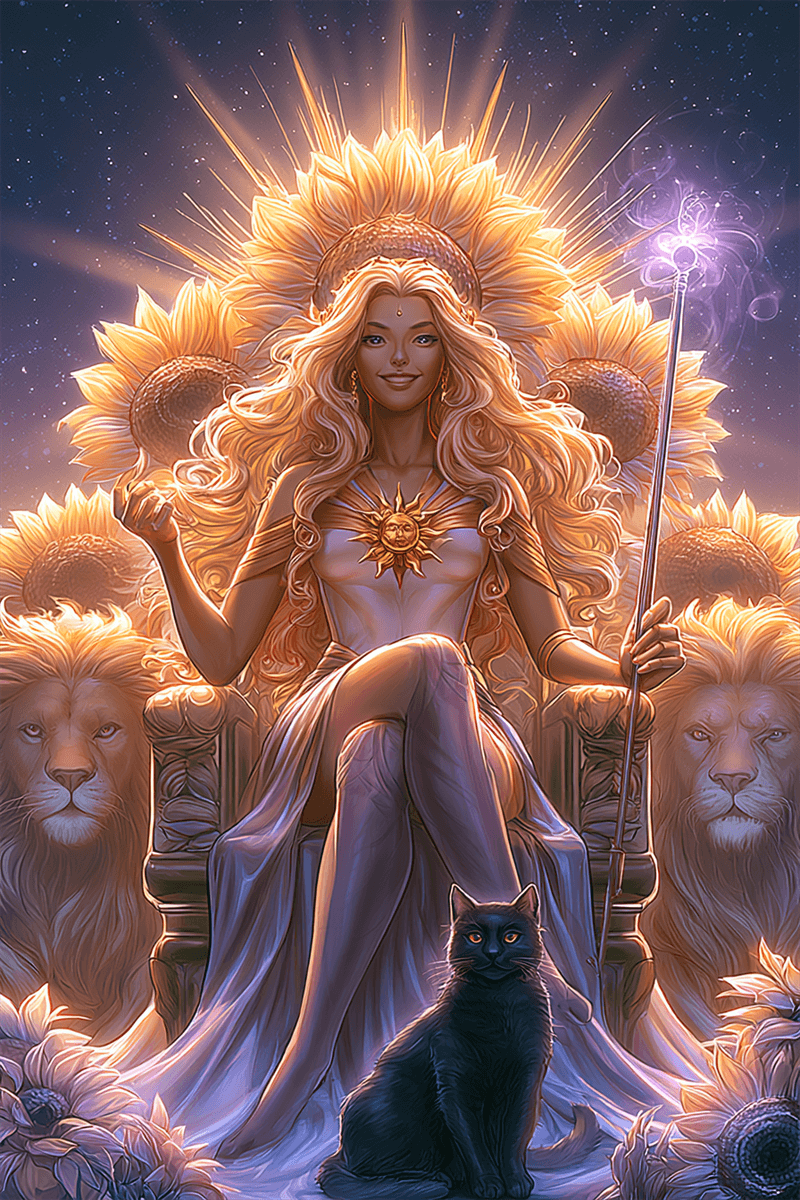
Pamela Colman Smith placed a queen on a throne decorated with lions and sunflowers, holding a flowering wand in her left hand and a sunflower in her right. A black cat sits at her feet, and her crown and the sunflower heads turn to face the viewer. Behind her stretches a yellow desert under a pale sky, with hills on the horizon. The image radiates a warm, magnetic authority.
Key Symbolism
The lions on the throne are the fire sign Leo, the suit's kingly sign; the sunflowers are the sun, the planet that rules Leo. The black cat is the domesticated shadow, the night-side of fire kept close as a familiar. The flowering wand is the living will held easily in the hand of one who has mastered it. The card captures fire as attraction rather than pursuit — the sovereign whose presence draws what she desires.
Across Traditions
The Marseille Reine is an enthroned court figure with no narrative. Smith's illustration gave her the warm, magnetic authority that has defined the card ever since. In the Thoth deck Crowley titles the card the 'Queen of the Thrones of Flame', attributing it to Water of Fire — the fluid, receptive aspect of the suit. The Thoth Queen is shown with a leopard at her feet and a wand topped by a pinecone, embodying the watery, magnetic pole of fire.
Cultural Context
The suit of Wands corresponds to the element of Fire, and the Queen represents the suit's receptive, magnetic pole: the fire that attracts rather than pursues. The figure of the enthroned queen reflects the medieval and Renaissance queen, the sovereign consort whose authority is exercised through presence rather than force. As the third court card of the suit she marks the moment when the Knight's pursuit has matured into settled, attractive power.