The Hierophant
The Hierophant tarot history: from Il Papa in Italian decks to the Rider-Waite-Smith pontiff between grey pillars, the embodiment of institutional spiritual tradition.
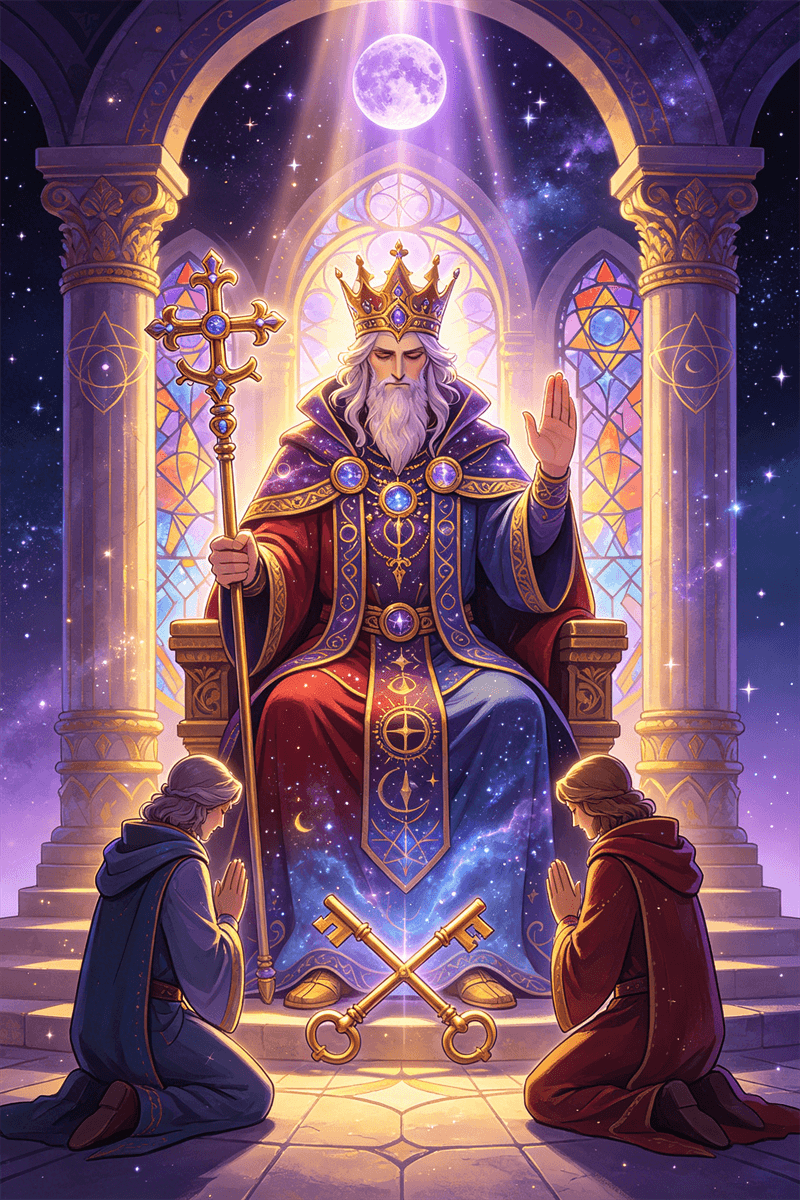
Etymology & Name
The Italian 'Il Papa' simply means 'the Pope' or 'father'. The name 'The Hierophant', from the Greek 'hierophantes' ('one who shows the sacred'), was introduced by Éliphas Lévi to de-Christianize the image. Waite adopted the Greek title, and it has become the standard English name for the trump.
Early Imagery
In the Visconti-Sforza deck the figure is overtly the Pope, triple-crowned and enthroned with the triple cross, possibly modeled on the antipope Felix V. The Marseille tradition retains the papal imagery, and in some regions the figure was censored: German decks replaced him with Jupiter, Belgian decks with Bacchus, and Bolognese tarocchino with a Moorish king.
Rider-Waite-Smith Design
Smith placed him between two grey stone pillars, wearing the triple tiara, blessing with two fingers raised and two lowered (again 'as above, so below'), and holding the triple cross. At his feet two tonsured clerks kneel, and crossed keys lie before him — the keys of Heaven, the Petrine symbol of papal authority.
Key Symbolism
The triple crown and triple cross denote jurisdiction over the three worlds — body, mind, and spirit, or earth, heaven, and the underworld. The crossed keys are the keys to the kingdom, access to sacred knowledge mediated by the institution. The grey pillars, unlike the High Priestess's black and white, suggest accessibility — tradition handed down openly rather than veiled.
Across Traditions
The Marseille Pope is a recognizable Catholic pontiff. Waite generalized him into the Hierophant, the teacher of exoteric religion. In the Thoth deck Crowley assigns him to Taurus and weaves in bull imagery and geometric forms, presenting him as the keeper of esoteric doctrine rather than ecclesiastical office.
Cultural Context
The Hierophant represents institutional religion, tradition, and the transmission of doctrine from teacher to disciple. He is the spiritual complement to the Emperor's secular rule. In modern readings he often appears as the archetype of the mentor or the established order — sometimes the source of wisdom, sometimes the authority that must be questioned.