The Hanged Man
The Hanged Man tarot history: its origin as Il Traditore, the Renaissance pittura infamante, and the Rider-Waite-Smith image of willing sacrifice with a halo.
Etymology & Name
The Italian 'L'Appeso' means 'the hanged one'. Crucially, early sources also call the figure 'Il Traditore' — the traitor — which reveals the card's original meaning. The image was one of shame and punishment, not mystical surrender.
Early Imagery
The card shows a man hung upside down by one foot from a wooden frame or tree, his hands often bound behind his back. Fifteenth-century documents explicitly name him 'the traitor'. The image comes directly from the Italian practice of 'pittura infamante' — shame paintings that city governments commissioned on the walls of public buildings to depict fugitive traitors hanging upside down.
Rider-Waite-Smith Design
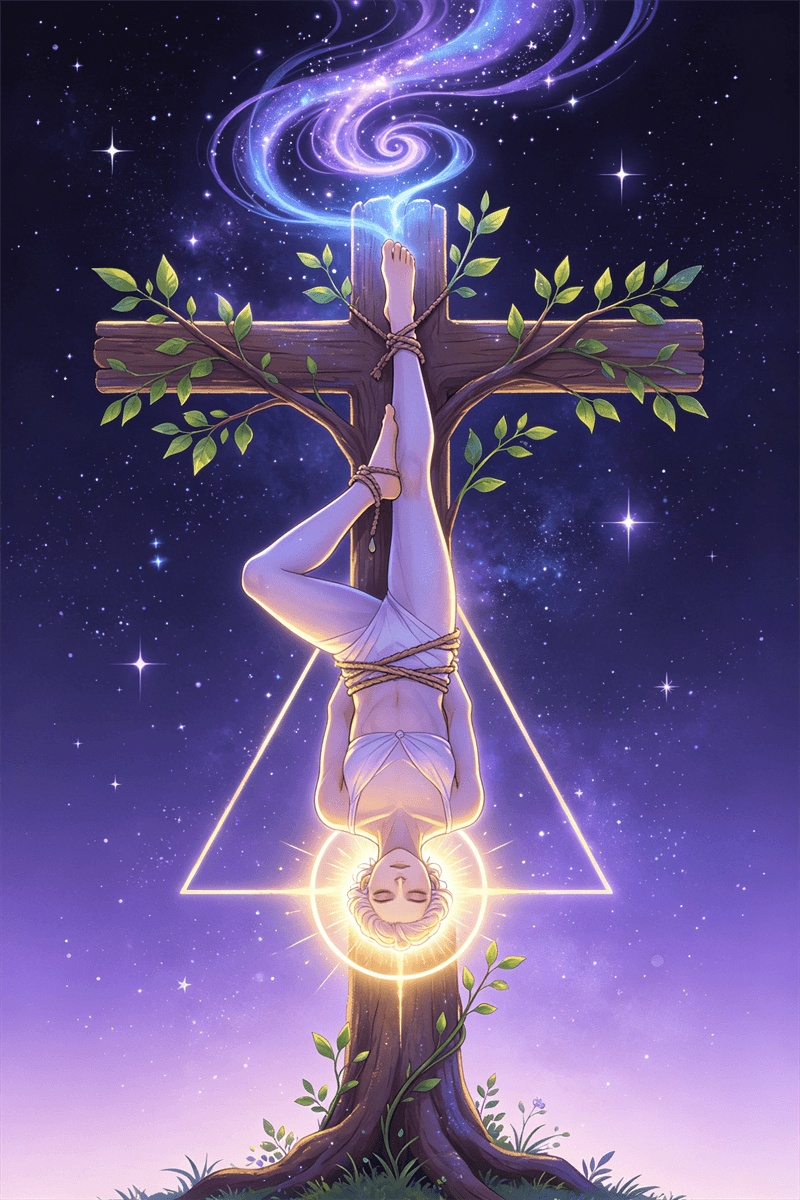
Smith transformed the disgraced traitor into a serene sacrifice. A young man hangs upside down from a T-shaped cross, one leg bound and the other folded behind it to form an inverted triangle. His head radiates a golden halo, and his face is calm. The frame bears twelve cut stumps, and his red tunic and blue hose give him the dignity of a holy figure.
Key Symbolism
The inversion is a reversal of perspective — seeing the world upside down. The halo marks the sacrifice as sacred and willing, not punitive. The crossed legs form the alchemical symbol of sulfur (△), signifying transformation, and the T-cross evokes the Tree of Life. The Hanged Man is the suspension that precedes insight.
Across Traditions
The Marseille figure is a punished traitor with no halo and no dignity. Waite invested him with willingness and enlightenment, making the card about voluntary surrender and changed perspective. In the Thoth deck Crowley keeps the name, attributes the card to the Hebrew letter Mem and the element of Water, and nails the figure to an ankh-shaped cross above Egyptian underworld motifs.
Cultural Context
The card draws on Saint Peter crucified head-down, Odin hanging nine days from the World Tree to win the runes, and shamanic initiation by inversion. The 'pittura infamante' practice — used by the Medici and Pope Pius II against enemies like Sigismondo Malatesta — is the documented historical source of the image, a rare case where tarot imagery can be traced to a specific civic custom.