The Sun
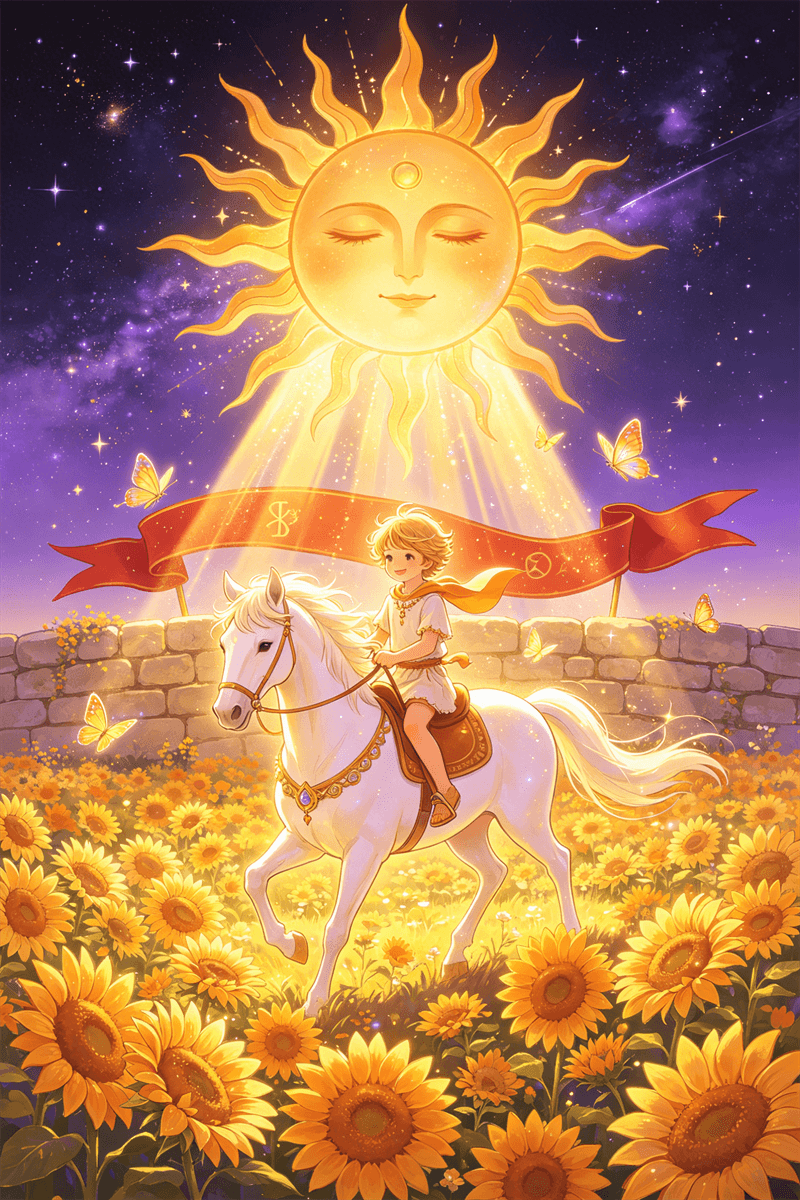
The Sun tarot history: the varying early images, the Marseille twins, and the Rider-Waite-Smith joyous child riding a white horse under a radiant sun.
Etymology & Name
From the Latin 'sol'. The sun was a universal symbol of divinity, illumination, and life-giving power long before tarot, and the card simply names that symbolism. Of all the trumps, the Sun underwent the most varied early imagery before settling into its modern form.
Early Imagery
Early tarot shows considerable variation: some decks depict an angel holding a sun, others a rider, others a simple sun face. The Marseille tradition settles on a radiant sun with a human face, beneath which two embracing brothers — or, in some versions, one adult and one child — stand in a sunlit garden.
Rider-Waite-Smith Design
Smith chose a single joyous image. A naked child rides a white horse out from behind a low wall, holding a great red flag. A huge sun with human face and twelve rays blazes above, and tall sunflowers turn their heads toward the light behind the wall. The mood is pure clarity and innocent triumph.
Key Symbolism
The sun is consciousness, illumination, and the life force at its zenith; the human face marks the divinity immanent in the self. The naked child is the inner child, unselfconscious and free; the white horse, the pure vitality that carries him; the red flag, the victory of life over death. The Sun is the unclouded joy that follows the Moon's uncertainties.
Across Traditions
The Marseille Sun shows two figures, often read as twins or as father and child. Waite reduced them to a single triumphant child. In the Thoth deck Crowley attributes the card to the Sun itself, depicts a twelve-rayed sun with a rose and scarab at its center, and places the green child Harpocrates — the god of silence — beneath it.
Cultural Context
The card draws on Apollo and Helios, on Christ as 'Sol Invictus', and on the alchemical 'rubedo', the final reddening that completes the work. Astrologically it corresponds to the Sun and, by affinity, to Leo. As trump number 19 it is the high point of illumination in the sequence — the clear day that rewards the passage through the Moon's night.