The Devil
The Devil tarot history: the missing early cards, the Marseille horned demon, and the Rider-Waite-Smith chained captives who could be free.
Etymology & Name
From the Latin 'diabolus', itself from the Greek 'diabolos' ('slanderer, accuser'). The figure is the Christian devil, and his presence in the trump sequence reflects the late-medieval demonology that culminated in the witch trials of early modern Europe.
Early Imagery
Notably, the Devil card is missing from nearly every surviving fifteenth-century hand-painted deck — the card was apparently removed and used in black magic rites, a fact documented in the Cary-Yale records. When the image reappears in the Marseille tradition, it is a horned, winged, clawed demon holding a torch.
Rider-Waite-Smith Design
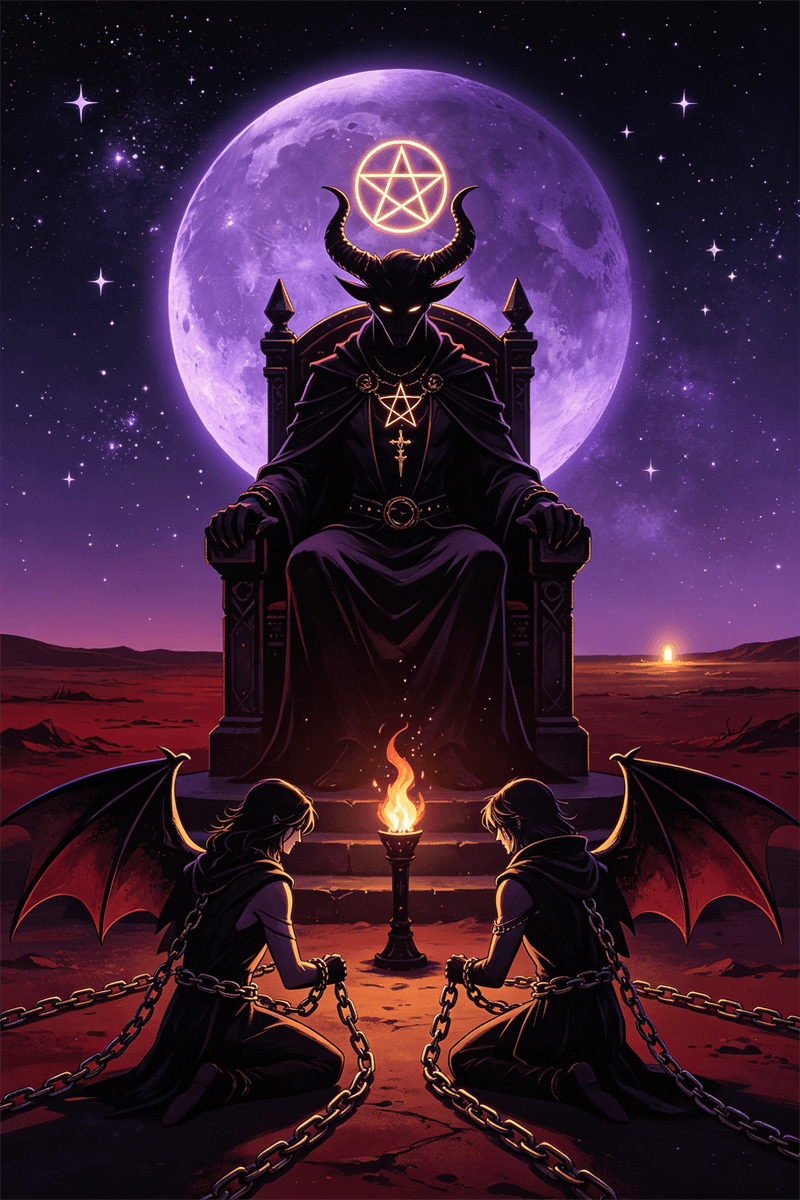
Smith placed the devil on a black pedestal, horned, with bat wings and eagle claws, one hand raised and the other lowering a torch. Two naked, horned humans are chained to the block beneath him — but the chains are loose around their necks. They could slip free; they do not. Above the devil's brow glows an inverted pentagram.
Key Symbolism
The horns, bat wings, and torch signify unbridled appetite and the fire of desire turned downward. The loose chains are the card's central insight: bondage to the devil is voluntary, maintained by ignorance of one's own freedom. The inverted pentagram marks spirit submerged by matter. The Devil is not a foreign enemy but the shadow we refuse to face.
Across Traditions
The Marseille devil brandishes a torch over two small captives. Waite's key addition is the loose chains — the bondage is self-imposed. In the Thoth deck Crowley keeps the name, attributes it to Capricorn, and renders the devil as a goat with an eye, a tongue, and intertwined generative organs — the blind creative force of nature.
Cultural Context
The card draws on Lucifer, on Éliphas Lévi's Baphomet (the goat-headed hermaphroditic idol he drew in 1854), and on the medieval carnival devil. Astrologically it corresponds to Capricorn. In Jungian terms it is the Shadow — the repressed desires that gain power precisely because they are denied. As trump number 15 it names the darkness that must be recognized before it can be integrated.